
Growing a business can turn HR from a few spreadsheets and payroll tasks into a daily administrative headache. The best HR software for small to medium businesses brings employee records, payroll, benefits, hiring, time tracking, and compliance tools into one place without forcing a growing company into an enterprise system it does not need.
The right platform should make routine HR work easier without creating another layer of work for your team. Some businesses need payroll at the center, while others need better employee management, international hiring, or a closer connection between HR and IT. Price is one consideration, along with setup time, integrations, reporting, and the features you will need as your workforce grows.
Table of Contents
Quick Summary: Top HR Software Picks
Best for SMBs: BambooHR
A people focused HR platform covering employee records, hiring, onboarding, time off, performance, reporting, and related HR tasks.
Best for All in One HR and IT Operations: Rippling
A workforce platform that brings HR, payroll, IT, finance, applications, and device management together.
Best for Integrated Payroll and Benefits: Gusto
A payroll centered platform with tax filing, benefits administration, time tracking, and HR tools for small businesses.
Best for Global Remote Teams: Deel
A global employment platform covering international employees, contractors, payroll, compliance, and Employer of Record services.
Best Budget Friendly Option: Zoho People
A lower cost HRIS covering employee records, attendance, leave, timesheets, documents, and employee self service.
What to Look For in SMB HR Software
The right HR platform depends on the size of your workforce, where your employees are located, and the administrative work taking up most of your team’s time. A 15-person company primarily needs payroll, employee records, onboarding, and time off, whereas a 200-person team relies on recruiting, performance management, benefits, reporting, and advanced workflows.
Payroll and Tax Filing
Payroll is often the first HR process that becomes difficult to manage manually as a company grows. Look for automatic calculations, tax filings, direct deposit, payroll reporting, and support for the states or countries where your employees work. Gusto handles payroll tax calculations, filings, and payments on supported plans, while its higher tier adds multi state payroll and additional HR capabilities.
Hiring and Onboarding
An applicant tracking system keeps candidate information, applications, interviews, offers, and hiring stages together. Once someone joins the company, onboarding tools can handle documents, signatures, employee information, and the tasks that need to happen before the first day. BambooHR includes hiring and onboarding tools such as candidate records, job posting, offer letter templates, new hire packets, onboarding checklists, and electronic signatures.
Time, Attendance, and Leave
Time tracking becomes increasingly useful when a business has hourly workers, multiple shifts, remote employees, or teams working across several locations. Zoho People includes attendance, shift management, timesheets, leave management, mobile check ins, and location based restrictions.
Integrations and Growth
Your HR software should work alongside the systems your business already uses. Payroll, accounting, recruiting, communication, identity management, benefits, and other workplace tools may all need access to employee information. Rippling takes this further by connecting HR with payroll, IT, finance, applications, and device management, giving businesses a single platform for several workforce processes.
Compliance Support
HR software can reduce some of the administrative work around payroll taxes, employee records, benefits, training, and workplace processes, although it does not replace legal or professional advice. Location is also important. A company operating in one state has fewer payroll and employment administration requirements than a business with employees spread across several states or countries.
Related Article: Best Cloud Call Center Software
Best HR Software Platforms
BambooHR
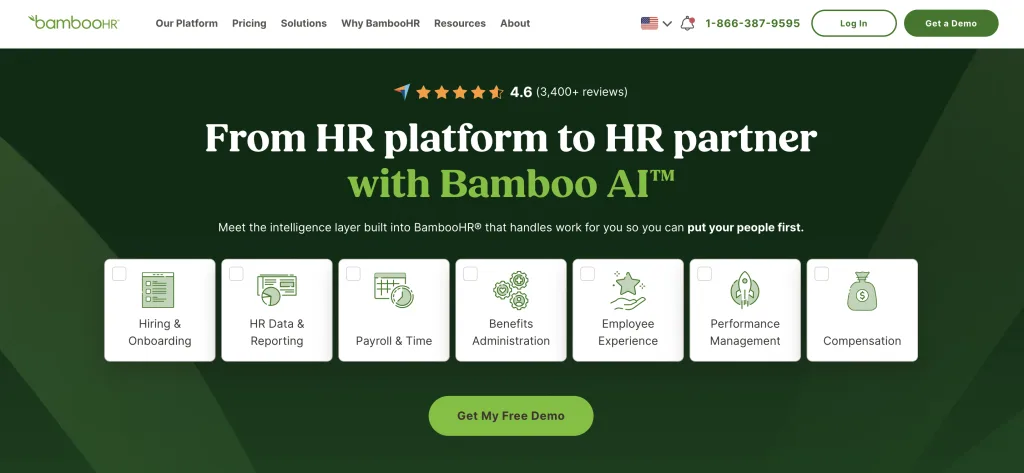
BambooHR is built around the core HR work that growing companies deal with every day. Employee records, hiring, onboarding, time off, benefits tracking, reporting, performance management, and employee experience tools all sit within the platform.
Its current US pricing starts at $10 per employee per month for Core, $17 for Pro, and $25 for Elite. Companies with 25 employees or fewer can instead start at a flat $250 per month. BambooHR also offers payroll, benefits administration, and time tracking as additional solutions.
The Pro plan adds 360 degree reviews, one on one management, performance reporting, employee community features, recognition, and rewards. Core already includes employee records, reporting, workflows, hiring and onboarding, time off, benefits tracking, and employee experience features.
Pros: HR focused platform, employee records, hiring and onboarding, time off, reporting, performance tools, and a broad integration ecosystem.
Cons: Payroll, benefits administration, and time tracking are offered as additional solutions, so the total cost can rise as you add more capabilities.
Pricing: Core starts at $10 per employee per month for companies with more than 25 employees. Companies with 25 employees or fewer start at $250 per month.
Rippling
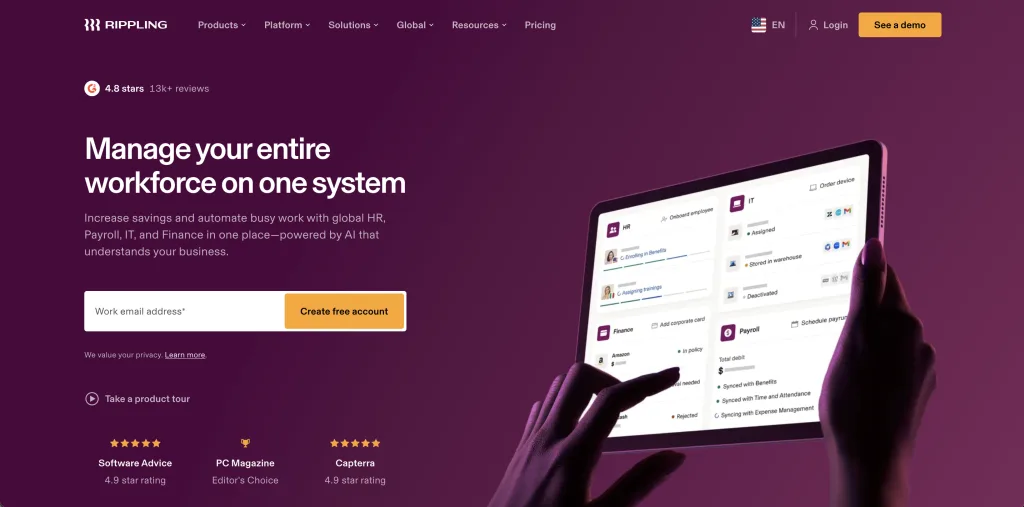
Rippling serves businesses that want HR to work closely with internal operations. Its platform connects HR, payroll, benefits, IT, finance, applications, and device management. The HR side covers employee data, onboarding and offboarding, benefits, recruiting, time and attendance, and performance management. Its IT capabilities cover areas such as identity management, application access, and device management.
Bringing HR into the rest of your tech stack makes messy internal tasks much easier to handle. Onboarding a team member involves far more than creating a basic profile; it touches payroll setup, benefit enrollments, software access credentials, access permissions, and hardware deployment simultaneously. Rippling skips fixed public plans in favor of custom proposals. Total costs depend on chosen features, structured around modular monthly base rates alongside fees calculated per user.
Pros: HR, payroll, IT, finance, application access, device management, and automation in one platform.
Cons: Its broad range of tools can be more than a small business needs if the main requirement is basic HR administration.
Pricing: Custom quote based on the products and services selected.
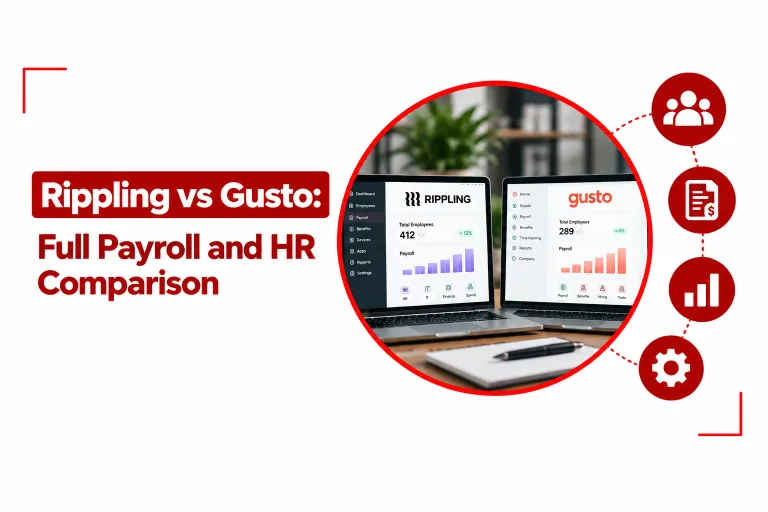
Related Article: Rippling vs Gusto: Full Payroll and HR Comparison
Gusto
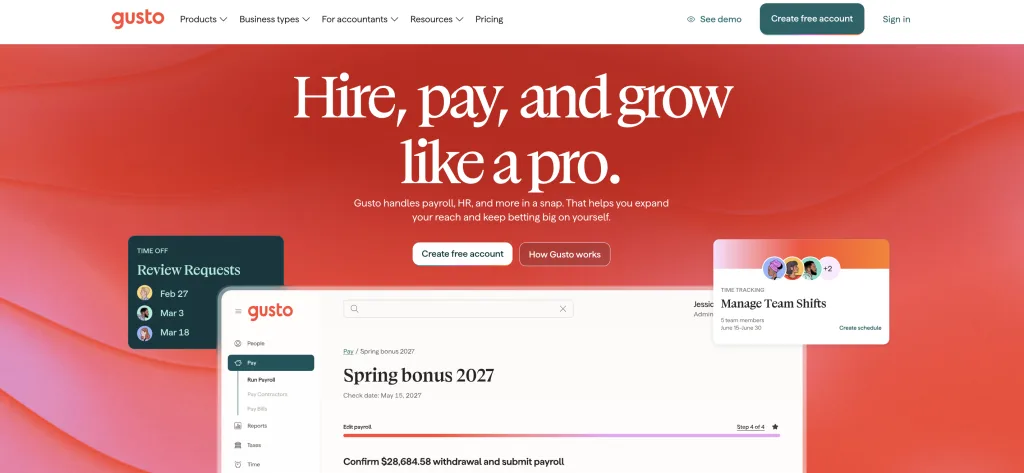
Gusto puts payroll at the center of its HR platform, making it a natural fit for small businesses that want payroll, benefits, and employee administration in one system. Its current Simple plan starts at $49 per month plus $6 per person. Plus starts at $80 per month plus $12 per person and adds features including multi state payroll and time tracking. Premium starts at $180 per month plus $22 per person and adds features such as dedicated support, certified HR experts, performance and compensation management, custom reports, and payroll migration assistance.
Gusto also supports automated payroll tax filings, W 2 and 1099 forms, new hire reporting, direct deposit, and benefits administration. Its benefits services cover areas such as health insurance, workers’ compensation, and retirement plans.
Pros: Payroll, tax filing, benefits administration, direct deposit, time tracking, and HR tools in one platform.
Cons: Businesses looking for extensive IT management or a broader workforce operations platform may need additional software.
Pricing: Simple starts at $49 per month plus $6 per person. Plus starts at $80 per month plus $12 per person, while Premium starts at $180 per month plus $22 per person.
Related Article: Deel vs Gusto: Which Payroll Platform Wins for Growing Businesses?
Deel
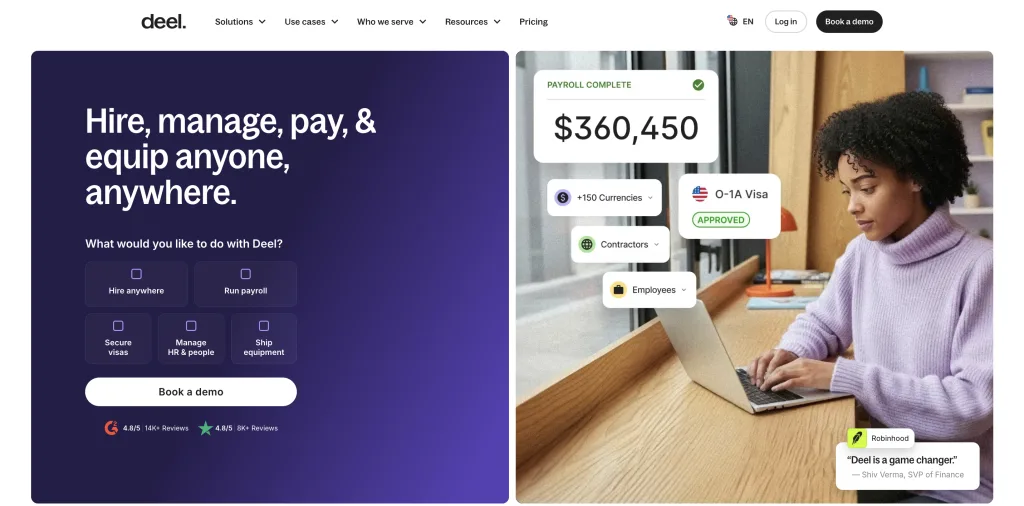
Deel is designed around international hiring and workforce management. Its services cover contractors, employees, global payroll, Employer of Record services, HR, compliance, and international payments. Deel HR starts at $5 per employee per month and includes worker profiles, organizational charts, time off, job architecture, workflows, approvals, anonymous reporting, and people analytics. Its higher HR levels add performance, goals, learning, surveys, workforce planning, and compensation management.
For international hiring, Deel currently lists contractor management at $49 per contractor per month and Employer of Record services at $599 per employee per month. Its EOR service covers contracts, payroll, benefits, and employment compliance across more than 130 countries.
That makes Deel particularly relevant for companies hiring across borders. A small business operating entirely within one country may not need its international employment services.
Pros: International hiring, EOR services, contractor management, global payroll, compliance, and HR administration.
Cons: EOR and international employment services cost substantially more than basic domestic HR software.
Pricing: Deel HR starts at $5 per employee per month. Contractor management starts at $49 per contractor per month, while EOR starts at $599 per employee per month.
Zoho People
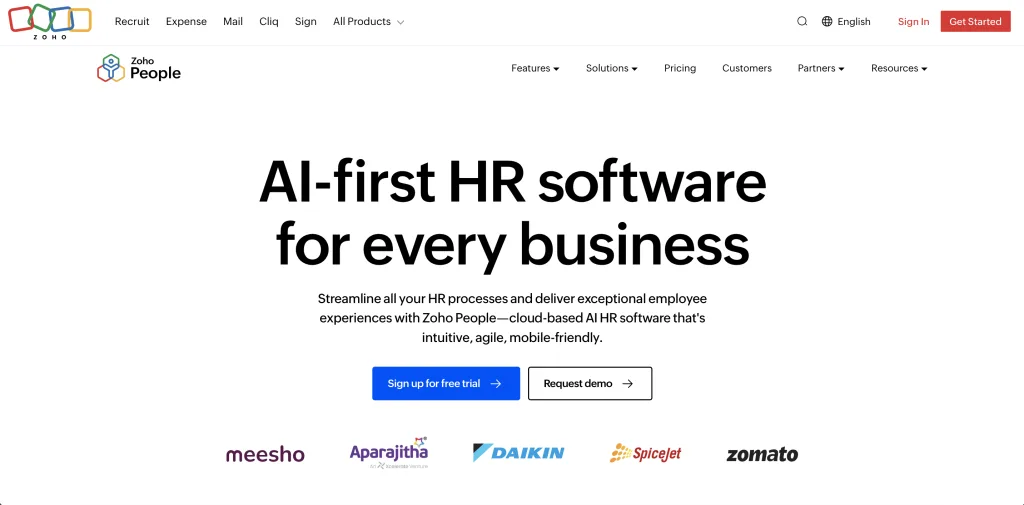
Zoho People focuses on core HR administration and offers a lower cost entry point for smaller companies. The platform covers employee records, employee self service, onboarding, offboarding, attendance, leave, timesheets, documents, HR help desk functions, and reporting. Its attendance features include mobile access, location based restrictions, shift management, and time tracking.
Zoho People’s pricing structure includes a free plan and paid tiers that start at $1.25 per user per month when billed annually. Higher tiers add more HR and workforce management features. Payroll is not the central function of Zoho People, so businesses that need full payroll processing may need Zoho Payroll or another payroll provider alongside it.
Pros: Low entry price, employee records, attendance, leave, timesheets, documents, mobile access, and employee self service.
Cons: Companies looking for full payroll processing may need another Zoho product or an external payroll service.
Pricing: Free plan available, with paid annual plans starting at $1.25 per user per month.
Essential HR Software Features for SMBs
The feature list is only part of the decision. What counts is how well those tools fit your company’s day to day work. These are the areas worth checking before you commit to an HR platform.
Payroll Processing
Payroll can range from straightforward single state processing to multi state and international payroll. Gusto puts payroll and tax filing at the center of its platform, while Rippling connects payroll with HR, IT, finance, and workforce management. Deel is built around international employees, contractors, global payroll, and EOR services.
Onboarding and Offboarding
Good onboarding software should reduce the number of separate tasks HR has to chase. Employee information, documents, signatures, benefits, payroll, training, software access, and equipment can all form part of the process. BambooHR focuses on employee records, hiring, onboarding, and people administration, while Rippling connects onboarding with payroll, IT, applications, and device management.
Time and Attendance
For hourly teams, attendance data can feed directly into payroll and help managers keep track of hours, shifts, overtime, and time off. Zoho People offers attendance tracking, mobile check ins, location based restrictions, shift management, timesheets, and leave tools. BambooHR also offers time tracking as an additional solution, with time clocks, timesheets, approval workflows, and automatic overtime calculations.
Performance Management
Performance tools become more useful as a company adds managers and larger teams. Look for goal setting, review cycles, feedback, compensation planning, and reporting if those processes are part of your HR operation. BambooHR includes performance management, 360 degree reviews, one on ones, and goal tracking in its Pro plan. Gusto includes performance and compensation management in Premium, while Deel’s higher HR levels add performance and goals.
How to Choose the Right HR Software for Your SMB
Start with the HR problems that are consuming the most time. If payroll is the main headache, a payroll focused platform such as Gusto may make sense. If employee records, hiring, onboarding, and performance are taking up most of the team’s time, BambooHR offers a broader HR focused setup.
The size and structure of your workforce should shape the decision too. A company with fewer than 20 employees may not need the same automation as a business with 150 employees across several states. Once the workforce grows, benefits administration, recruiting, performance reviews, reporting, access management, and payroll requirements can become much more involved.
International hiring changes the equation again. Deel is built around employees and contractors working across borders, while Rippling combines global workforce administration with HR, payroll, IT, and other workplace systems.
Pricing deserves a close look beyond the headline figure. Check the base platform charge, per employee fees, payroll costs, benefits administration, time tracking, recruiting, implementation, and any other features your team will need. A low starting price can become less attractive after several add ons, while a more expensive platform may replace several separate tools.
Frequently Asked Questions
What is the difference between an HRIS, HRMS, and HCM?
An HRIS, or Human Resources Information System, usually focuses on employee records and core HR administration such as personal information, documents, time off, and reporting.
HRMS, or Human Resource Management System, is often used for a broader set of HR functions that can include payroll, attendance, recruiting, benefits, and performance management. HCM, or Human Capital Management, generally covers an even wider range of workforce functions, including talent management, compensation, learning, workforce planning, and analytics.
In practice, software companies often use these terms interchangeably, so the feature set is more useful to compare than the label attached to the product.
How much does HR software cost for a small business?
The price can range from free plans to several hundred dollars per month, depending on the platform and the number of employees.
Zoho People offers a free plan and paid plans starting at $1.25 per user per month when billed annually. Deel HR starts at $5 per employee per month, while BambooHR’s Core plan starts at $10 per employee per month for companies with more than 25 employees. Gusto starts at $49 per month plus $6 per person on its Simple plan. Payroll, benefits, recruiting, international employment, and other services can add to the total cost.
Can small business HR software handle automated tax filings?
Yes, several HR and payroll platforms offer automated tax filing. Gusto handles federal, state, and local payroll tax filings on supported plans. BambooHR Payroll also includes federal and state tax filing for its US payroll service.
The exact coverage depends on the platform, plan, employee locations, and type of tax involved, so check the provider’s current payroll coverage before signing up.
Do SMBs need dedicated HR software if they already use accounting software?
Accounting software can handle some payroll and financial tasks, but it may not cover the full employee lifecycle. Recruiting, onboarding, employee records, time off, performance reviews, benefits, documents, and workforce reporting can require dedicated HR tools. For a very small team, accounting software may be enough for basic payroll. As hiring increases and employee administration becomes more involved, an HRIS or broader HR platform can bring those processes into one system.
The best choice depends on the work your team needs to manage. A business primarily dealing with payroll may lean toward Gusto, while a growing HR team may need the employee management capabilities of BambooHR. Companies combining HR with IT may find Rippling more suitable, international teams may need Deel, and businesses focused on keeping software costs low can look closely at Zoho People.