
Cloud call center software has changed how businesses handle customer calls, sales conversations, support requests, and digital messages. Organizations run their contact center online through cloud infrastructure, bypassing office phone servers and physical equipment. The best cloud call center software now goes beyond basic phone calls. Modern platforms can handle voice, SMS, chat, email, call routing, CRM updates, reporting, workforce management, and AI tools from one system.
For a small sales team, a simple platform such as Aircall may be enough. Larger contact centers may need the advanced routing, workforce management, and AI capabilities found in Five9 or Genesys Cloud CX.
Table of Contents
Top Cloud Call Center Software Compared
The right platform depends on team size, communication channels, CRM requirements, and the level of automation you need. Here is a quick look at six widely used cloud contact center platforms.
| Software | Starting Price | Team Size | Omnichannel | CRM Integration | AI Tools |
|---|---|---|---|---|---|
| Five9 | $119/user/month | 50 seat minimum | Yes | Yes | Yes |
| RingCentral RingCX | $65/user/month | Flexible | Yes | Yes | Yes |
| Nextiva | $75/agent/month | Up to 100 agents on Scale | Yes | Yes | Yes |
| Genesys Cloud CX | $75/user/month | Flexible | CX 2 and above | Yes | Yes |
| Aircall | $30/user/month | 3 user minimum | Voice plus messaging | Yes | Yes |
| Talkdesk | $85/user/month for Digital Essentials | Flexible | Yes | Yes | Yes |
Prices can depend on billing terms, usage, add-ons, and the plan you choose.
Which Cloud Call Center Software Fits Your Team?
- For small teams: Aircall has a low starting seat count and a simple setup focused on business calling and CRM connections.
- For growing contact centers: Nextiva combines voice, chat, routing, AI transcription, and customer journey tools in its contact center plans.
- For outbound sales: Five9 includes dialer capabilities, blended inbound and outbound calling, CRM connections, and AI tools.
- For enterprise omnichannel operations: Genesys Cloud CX and RingCentral RingCX support voice and digital channels alongside advanced routing, analytics, and AI features.
- For industry specific contact centers: Talkdesk has plans built around healthcare, financial services, retail, travel, utilities, and other industries.
Key Benefits of Cloud Call Center Platforms
Cloud contact center software removes much of the hardware and maintenance associated with traditional phone systems. Agents can work through a browser, desktop application, or mobile device while supervisors manage calls and customer interactions through a central dashboard.
Remote Call Center Support
A cloud platform lets agents handle customer conversations from home, another office, or another location with a reliable internet connection. Calls, customer records, queues, and team communications can stay inside the same workspace. This setup works well for companies with remote or distributed teams. Managers can also add agents without installing a phone system at each employee’s location.
Faster Team Scaling
Adding a new agent usually involves creating a user account, assigning a phone number or extension, and giving the person access to the required queues and tools. That makes cloud systems easier to expand as call volumes increase. Businesses also avoid maintaining physical phone servers, office hardware, and dedicated contact center infrastructure.
Lower Infrastructure Costs
Traditional call centers can require servers, phone equipment, wiring, maintenance contracts, and IT support. Cloud platforms shift much of that infrastructure to the service provider. Most providers use subscription pricing based on users, agents, usage, or selected features. Your actual monthly cost can also include phone numbers, international calling, AI usage, storage, and other add-ons.
Centralized Customer Data
Cloud call center tools can connect phone conversations with CRM and help desk records. An agent can see customer details, previous interactions, call history, and notes without switching between several systems. Aircall, for example, has more than 250 integrations covering CRM, help desk, and business applications.
Related Article: Best B2B E-commerce Inventory Management Software
Best Cloud Contact Center Software
Five9
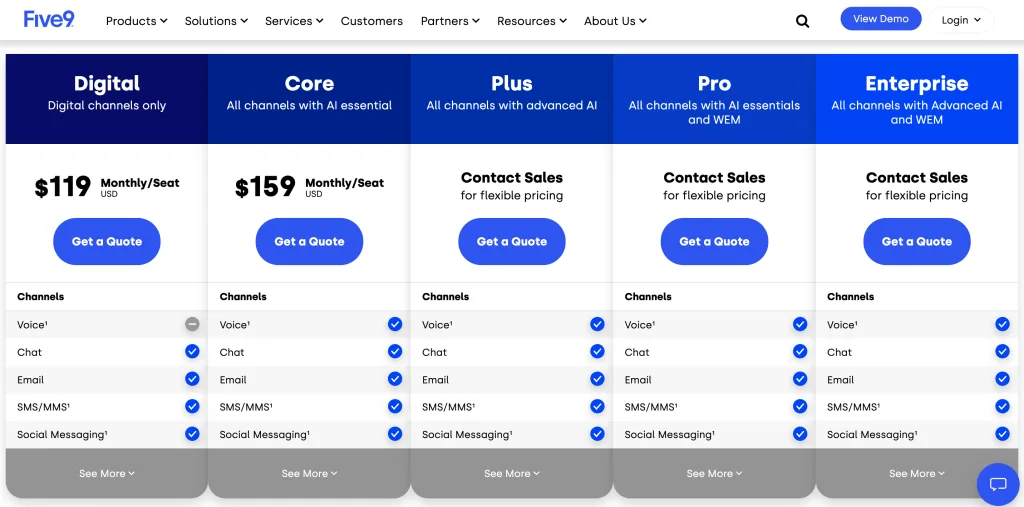
Five9 is built for contact centers that need advanced call handling, outbound dialing, digital channels, AI assistance, and workforce management. Five9 pricing starts at $119 per seat monthly for Digital and $159 for Core, subject to a 50-seat minimum. The Core plan includes voice, chat, email, SMS/MMS, social messaging, AI summaries, live transcription, agent assist, recording, dialer tools, CRM connections, analytics, and workforce management options.
Five9 connects with platforms such as Salesforce, ServiceNow, Microsoft Dynamics, Zendesk, and Oracle. Its AI features include live transcription, AI summaries, agent assistance, and AI insights.
Best for: Mid sized and enterprise contact centers, outbound sales teams, and organizations handling large call volumes.
RingCentral RingCX
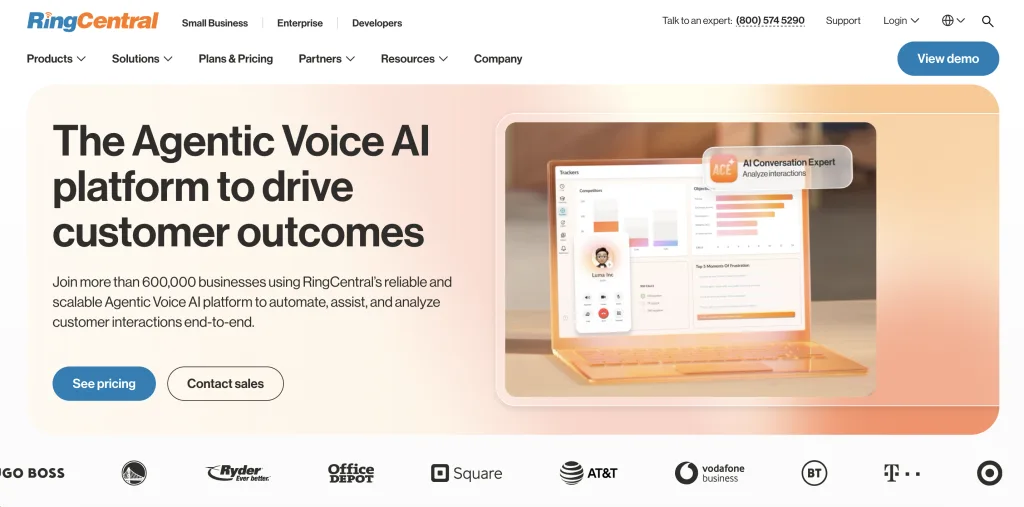
RingCentral RingCX brings voice, digital messaging, AI, outbound dialing, and customer interaction management into one contact center platform. RingCX starts at $65 per user monthly and includes unlimited minutes in its entry tier. The platform supports voice alongside 20+ digital channels, combining native AI agents, outbound tools, and smart call routing into a single interface.
RingCX also connects with RingCentral’s broader communications environment, making it useful for companies already using RingCentral for business calling and collaboration. Built-in security frameworks support SOC 2, HIPAA, PCI DSS, GDPR, and HITRUST compliance.
Best for: Companies that want contact center features alongside a broader business communications platform.
Nextiva
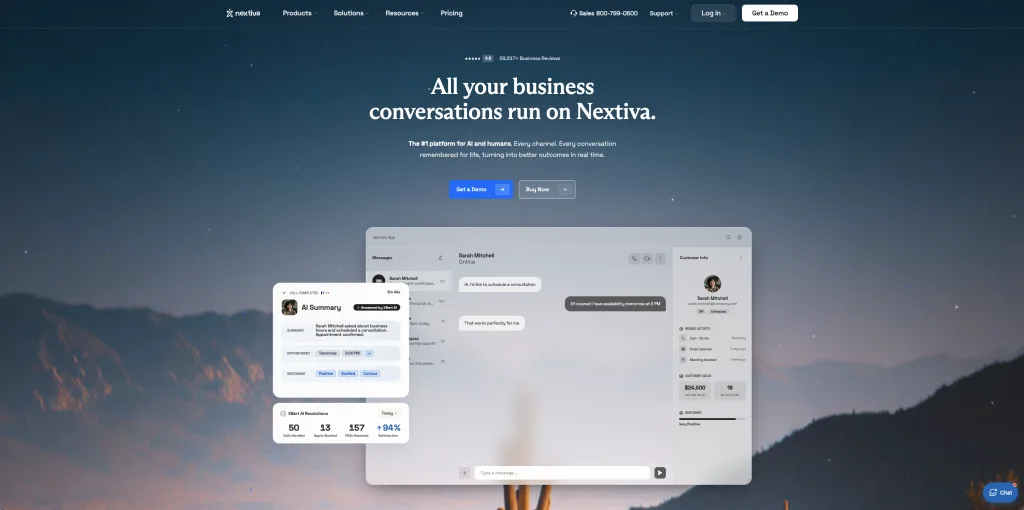
Nextiva merges business calling with contact center functionality for organizations expanding from standard phone lines into structured sales and support workflows. Its current contact center pricing starts at $75 per agent per month for the Essential plan. This includes voice and web chat, omnichannel capabilities, journey orchestration, AI transcription and summaries, and skills based routing. Higher plans add more channels, self service tools, predictive dialing, workforce management, and advanced analytics.
Nextiva also has lower priced business communication plans starting at $15 per user per month, with its Engage plan at $25 per user per month adding inbound call center features, live chat, chatbot tools, and advanced reporting.
Best for: Growing businesses that want business communications and contact center functions in the same ecosystem.
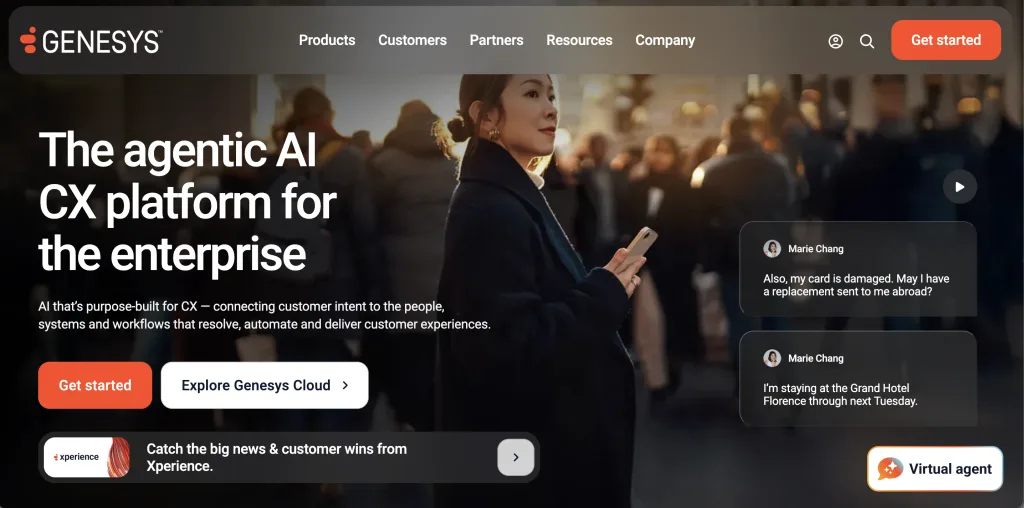
Genesys Cloud CX
Genesys Cloud CX targets organizations running larger and more complex contact centers. Its platform covers voice, digital channels, routing, analytics, workforce management, quality assurance, virtual agents, and AI assistance. Annual plans for Genesys Cloud CX scale across three main tiers: CX 1 at $75 per user monthly for core voice, CX 2 at $115 for digital channels and omnichannel routing, and CX 3 at $155 for workforce management, scheduling, and quality assurance.
Genesys also includes predictive routing, speech and text analytics, virtual agents, Agent Copilot, and Supervisor Copilot across its published plans.
Best for: Enterprise contact centers that need advanced routing, workforce management, analytics, and AI.
Aircall
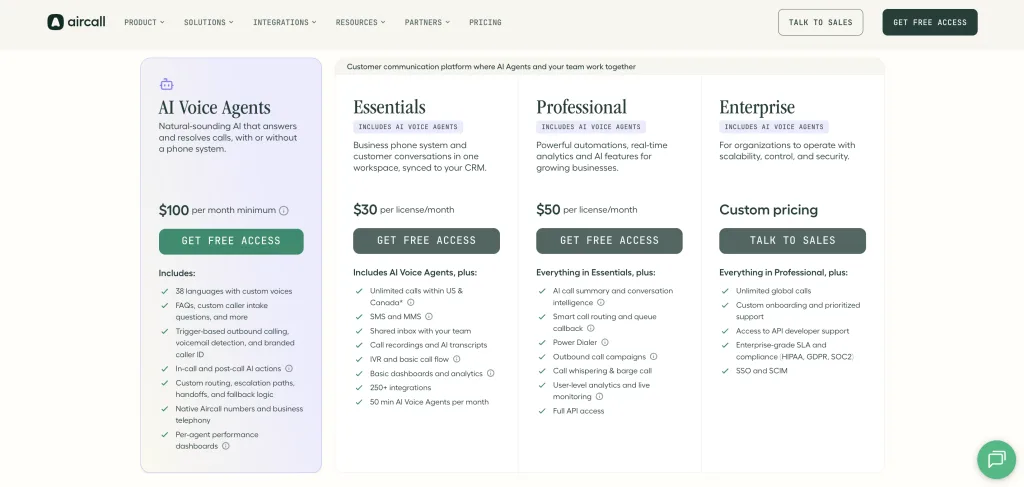
Aircall is serves at businesses that want cloud calling without the complexity associated with larger enterprise contact center platforms. Its Essentials plan starts at $30 per license per month when billed annually, with a minimum of three licenses. Professional starts at $50 per license per month. The platform includes IVR, call recording, click to dial, SMS and MMS, softphone apps, analytics, and more than 250 integrations.
Aircall connects with tools such as Salesforce, HubSpot, Zendesk, Zoho, Pipedrive, and Microsoft Teams.
Best for: Small and growing sales or support teams that want quick deployment and CRM connected calling.
Talkdesk
Talkdesk focuses on cloud contact center operations across voice, digital channels, AI, routing, reporting, and workforce management.
Talkdesk entry plans start at $85 per user monthly for digital and $105 for voice. The $165 Elite plan introduces workforce management, performance tools, screen recording, and advanced analytics, while specialized Industry Experience Clouds start at $225 per user monthly. Talkdesk also supports healthcare, financial services, insurance, retail, travel and hospitality, utilities, and other industry focused environments.
Best for: Contact centers that need industry specific tools, voice and digital engagement, and workforce management.
Related Article: Best HR Software for Small to Medium Businesses
Essential Features of Cloud Call Center Software
Monthly seat costs only tell half the story when picking a contact center platform. Look at how agents handle calls, how customer information moves into your CRM, and how much work supervisors need to do manually.
Smart Call Routing and IVR
Interactive Voice Response, or IVR, lets callers choose options before reaching an agent. More advanced systems can route calls based on skills, customer history, language, department, agent availability, or queue conditions. Automatic callbacks can also reduce the need for customers to stay on hold during busy periods. For sales teams, outbound dialers can help agents work through large contact lists.
Native CRM and Help Desk Sync
CRM integration can save agents from entering the same information in several systems. Look for features such as screen pops, automatic activity logging, click to dial, call notes, contact synchronization, and two way data updates. Aircall has more than 250 integrations, while Five9 connects natively with major CRM and service platforms like Salesforce, ServiceNow, Dynamics, and Zendesk.
AI Assistance and Analytics
AI has become a major part of modern contact center software. Common tools include live transcription, conversation summaries, agent assistance, sentiment analysis, virtual agents, and automated quality reviews. Genesys Cloud CX includes speech and text analytics, Agent Copilot, Supervisor Copilot, virtual agents, and predictive routing. Five9 includes AI summaries, live transcription, AI insights, and Agent Assist in its published plans.
The true value lies in how easily these tools handle day to day work. A contact center may gain more from automatic call summaries and CRM updates than from an AI feature that agents rarely use.
Workforce Engagement Management
Large contact centers need tools for scheduling, quality monitoring, call recording, forecasting, and agent performance. Genesys Cloud CX 3 includes workforce management, forecasting, scheduling, quality assurance, and employee performance tools. Talkdesk Elite also includes workforce management, performance management, and screen recording.
Smaller teams may not need this level of functionality. Paying for advanced workforce tools can make little sense for a support team with only a few agents.
Implementation and Compliance Considerations
Cloud deployment is usually simpler than building an on premise contact center, but your IT team still needs to review network quality, integrations, user permissions, data handling, and compliance requirements.
Security and Regulatory Standards
Start with the regulations that apply to your business and the information your agents handle. Healthcare organizations may need HIPAA related controls. Businesses taking card payments through customer conversations may need PCI DSS controls. Companies serving customers in Europe may also need GDPR support.
Five9 maintains compliance across SOC 2 Type 2, PCI DSS, HIPAA, and GDPR standards within its platform Trust Center. RingCentral aligns its RingCX services with similar enterprise benchmarks, securing certifications for SOC 2, HIPAA, PCI DSS, and global data privacy standards. A certification does not automatically make your entire contact center compliant. Your configuration, data handling, retention rules, user access, and internal processes still need review.
Network and Call Quality
Cloud calling depends on a stable internet connection. Poor bandwidth, network congestion, packet loss, and high latency can affect call quality. Before deployment, test the locations where agents will work. Review the provider’s uptime commitment, network architecture, voice quality tools, and support process.
Deployment and Agent Training
A basic cloud phone system can be ready quickly, but a full contact center deployment can take longer once CRM connections, IVR menus, routing rules, call recording, reporting, and workforce schedules are included. Plan time for testing before agents begin handling live customers. Training should cover the agent interface, call transfers, queues, customer records, recordings, status settings, and escalation procedures.
The best cloud call center software depends on the type of contact center you are building.
Aircall makes sense for small teams that want cloud calling, CRM integrations, IVR, and a quick path to deployment. Nextiva works well for businesses that want business communications and contact center tools in the same environment.
Five9 is built for larger operations that need outbound dialing, AI assistance, digital channels, CRM connections, and workforce management. Genesys Cloud CX goes further into routing, analytics, workforce management, and AI for enterprise contact centers.
RingCentral RingCX sits between business communications and full contact center operations, with voice, digital channels, AI, and outbound tools. Talkdesk is a fit for teams that need cloud contact center features alongside industry specific capabilities.
For a small sales or support team, start with the agent experience, CRM integrations, and monthly cost. For a large contact center, give more attention to routing, workforce management, analytics, security, and AI capabilities. The platform should fit the way your agents already work while leaving room for your contact center to grow.