
Africa’s digital divide is entering a new phase. Across the continent, mobile networks now reach most people, smartphones are common in many cities, and digital payments, social platforms, online commerce, remote work, and mobile banking have changed daily life. The harder question is becoming what people can actually do once they are connected.
A phone with an internet connection can open a bank account, send a message, watch a tutorial, or search for information. AI adds another layer of capability, helping people analyse documents, compare large amounts of information, write software, translate content, automate repetitive tasks, or turn an early idea into a usable product. The value of these tools goes beyond simply having an internet connection. It also depends on knowing how to use AI effectively, check its output, protect sensitive information, and use it for meaningful tasks.
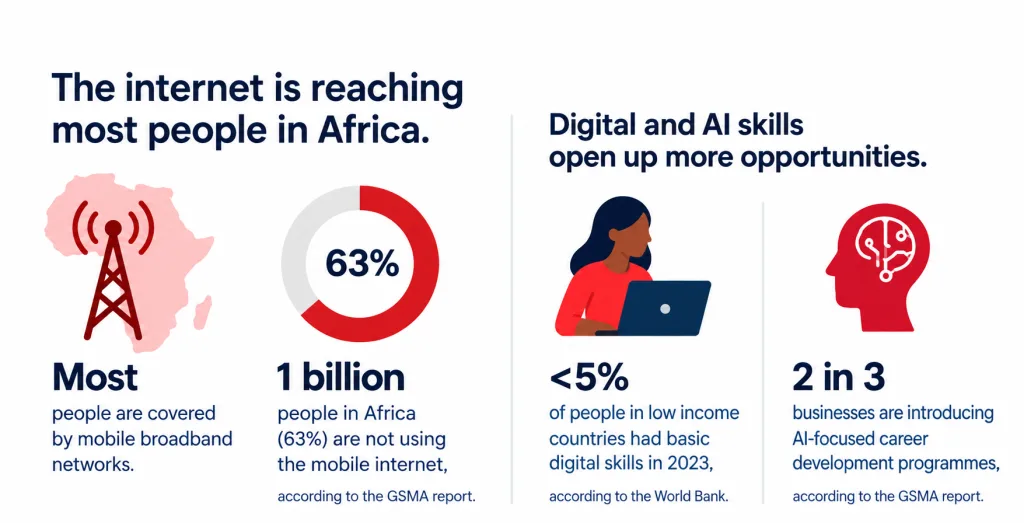
The GSMA Mobile Economy Africa 2026 report puts the mobile internet usage gap at almost 1 billion people, or 63% of Africa’s population, even though mobile broadband coverage reaches most of the continent. Only about 9% of Africans remain outside mobile broadband coverage. The same report puts mobile technology’s contribution to Africa’s economy at $240 billion in 2025, equal to 7.8% of GDP, with the mobile ecosystem supporting about 13 million jobs and generating $45 billion in public revenue.
A mobile signal can put people online without giving them the skills to make full use of what the internet offers. Internet access opens the door to the digital economy, while AI literacy can shape how people work, learn, create, and earn within it.
Internet Access Is Only the Beginning of the Digital Divide
Africa has spent years expanding the physical foundations of digital access. Fibre networks, mobile broadband, smartphones, cloud services, and 4G and 5G networks have made online services available to a much larger population. More than $76 billion in mobile network infrastructure investment is expected across Africa between 2024 and 2030, while 5G is projected to reach 21% of total mobile connections by 2030.
The figures also show why coverage alone cannot describe digital inclusion. GSMA reports that around 63% of Africans live in areas covered by mobile broadband but do not use mobile internet. Device prices, data costs, limited digital skills, and a lack of locally relevant content all influence that gap. A signal reaching a neighbourhood does not automatically translate into regular digital participation.
The economic stakes are substantial. Mobile technologies and services contributed $240 billion to Africa’s economy in 2025, showing how much value connectivity already supports across the continent. The same ecosystem supported about 13 million jobs and generated $45 billion in public revenue. The next question is how much additional value people can create as AI becomes part of ordinary work.
A person who uses the internet mainly for messaging and entertainment has a different digital experience from someone who can use a spreadsheet, automate a report, analyse customer data, test software, or work with an AI assistant. Both people are connected. Their economic opportunities can still be very different.
The World Bank’s Digital Progress and Trends Report 2025 makes this difference clearer at a global level. In April 2025, 24% of internet users in high income countries used ChatGPT, compared with 5.8% in upper middle income countries, 4.7% in lower middle income countries, and 0.7% in low income countries. Internet access explains part of the gap, but the difference also points to unequal levels of AI adoption and digital capability.
For Africa, the implication is important. The digital divide can no longer be measured only by asking who has a connection. It also has to account for what people can do with that connection, which digital tools they can use confidently, and how easily those tools connect to education, employment, business, and public services.
AI Literacy Is Becoming a Workplace Skill
AI literacy is broader than knowing how to write a clever prompt. A digitally capable worker needs to understand what an AI system can and cannot do, how to give it useful context, how to check an answer against reliable information, and when human judgement is still needed. In a workplace, the skill can extend into data handling, automation, document analysis, software development, customer service, research, and other daily tasks.
The business side of the gap is already visible. Research covering mid size and enterprise companies in Kenya, Nigeria, and South Africa found that 90% reported negative business effects from shortages of AI skills, including project delays, failed innovation efforts, and an inability to take on new work. The SAP Africa research on AI skills readiness also found AI skill shortages reported by 53% of South African companies, 50% of Nigerian companies, and 43% of Kenyan companies.
Demand is moving beyond specialist machine learning roles. In the same research, 85% of organisations identified AI development skills as a priority and 83% prioritised generative AI skills. Two thirds were introducing career development programmes with an AI specialisation. As AI moves into everyday business work, more employees will need to understand how to use these tools even if they are not developing the systems themselves.
The World Bank has found a similar change in the wider labour market. Demand for generative AI skills rose ninefold between 2021 and 2024, while jobs requiring those skills paid 25% more than similar jobs without them. High income economies accounted for roughly 70% of global demand for AI skills. The figures do not mean every AI capable worker will earn more, but they show that AI knowledge is becoming connected to economic opportunity.
Basic digital skills remain a major foundation. The World Bank’s AI Atlas reports that less than 5% of people in low income countries had basic digital skills in 2023. At that level, the gap is not simply about advanced AI training. Someone still developing confidence with online transactions, web searches, email, or digital tools is starting from a very different position from someone who can integrate AI into professional work.
This creates a layered form of digital inequality. One person may have a smartphone but limited data. Another may have reliable internet but little experience with digital tools. Someone else may use AI regularly but lack the skills to check inaccurate output. A software developer may have advanced technical skills but struggle to use AI effectively in a specialised field. Connectivity, digital literacy, AI literacy, and professional knowledge now overlap in ways that can shape how much value people receive from the same internet connection.
Information quality adds another concern. AI can produce convincing text, images, audio, and video at a speed that makes verification harder. People with digital literacy can compare sources, inspect claims, recognise manipulated material, and question suspicious content. People without those skills can face a different kind of exclusion, where access to more information does not necessarily mean access to better information.
Education, Local Data and Talent Will Shape Africa’s AI Divide
Skills do not develop in isolation. Schools, universities, employers, training providers, local technology communities, and public policy all influence the supply of people who can work with AI. The African AI Governance Index reports that 22 of the 55 African Union member states had published national AI strategies by April 2026, with another 21 in the drafting stage. The policy activity shows that governments are giving more attention to AI, although policy documents alone do not tell us how deeply AI skills have entered education and workforce training.
Education has a direct role because AI literacy can be introduced before people enter the labour market. Computer literacy already covers basic concepts such as files, software, search, communication, and online safety. AI literacy adds questions about automated systems, data quality, generated content, verification, privacy, and responsible use. At university level, the same foundation can connect with fields such as agriculture, medicine, finance, engineering, media, law, and public administration.
Local language is another part of the divide. Africa is home to more than 30% of the world’s languages, while many leading AI models rely heavily on English and other high resource languages. The GSMA report points to this language gap as one of the issues affecting AI development on the continent. The World Bank also notes that AI systems need relevant local data if they are to work well across different cultural, economic, and linguistic settings.
The computing gap is just as striking. As of June 2025, high income countries held 77% of global data centre capacity, while low income countries accounted for less than 0.1%. The World Bank’s AI foundations research also notes that AI can still reach countries without large domestic computing facilities through cloud services and smaller AI applications that run on everyday devices. Access to those tools, however, does not remove the need for people who understand how to use them well.
Talent movement adds another pressure. The World Bank report shows that countries including Nigeria have experienced digital talent outflows several times higher than their inflows. When highly trained workers move to employers abroad, local firms can lose people who might have trained colleagues, built products, managed AI projects, or developed local expertise. Remote work can connect African professionals to global companies, but it can also make the competition for skilled workers much wider.
This is where the next stage of the digital divide becomes more complicated than the old question of ‘who has internet access?’. A country can expand mobile coverage and still have large numbers of people with limited digital skills. It can produce graduates who know how to use computers and still have shortages of workers who can integrate AI into business processes. It can adopt a national AI strategy and still lack enough local data, computing capacity, teachers, trainers, and experienced professionals to turn policy into widespread use.
Africa’s digital future will be shaped by all of these layers at once. Network coverage remains important because people cannot use online services without access. Device affordability and data prices continue to influence adoption. Digital literacy shapes how confidently people use online services, while AI literacy increasingly affects how they work with new tools. Education, local language resources, computing capacity, and skilled workers then influence how deeply those tools can become part of the economy.
The digital divide is consequently moving beyond a simple question of connection. A person can be online and still have limited access to the economic value created by AI. As connectivity expands, the gap between having internet access and having the knowledge to use advanced digital tools may become one of the defining technology divides across Africa.