
For years, the Transsion’s Africa smartphone market dominance was the easiest story to follow if you wanted to see who sold the most phones for the least money. That simple strategy built the Chinese tech giant behind Tecno, Infinix, and itel. Low prices helped, but they were only part of the story.
Transsion succeeded because they paid attention to everyday details. They built phones that handled spotty power grids, held multiple SIM cards for shifting signal conditions, and matched local income realities. They signed up neighborhood phone shops, set up repair centers, and gave Tecno, Infinix, and itel distinct roles so the brands did not eat into each other’s sales. That ground-level focus paid off. Transsion grabbed around 48 percent of African smartphone shipments in 2025, holding off heavyweights like Samsung and Xiaomi.
Maintaining that lead is getting tougher. Parts costs are climbing, buyers want better specs, and the dirt-cheap phone market is shrinking. With rivals pushing hard into middle-tier pricing, Transsion has to figure out how to stay ahead when low prices are no longer enough.
How Transsion Found Its Edge in Africa
Transsion Holdings was founded in China in 2006 and built its international business around emerging markets. Its best known smartphone brands are Tecno, Infinix and itel, with Carlcare handling after sales service. The company now operates across more than 100 countries and regions. In 2025, it sold 169 million mobile phones globally, while its smartphone shipments ranked first in Africa, Pakistan, Bangladesh and the Philippines.
Africa, however, remains central to the company’s identity. Transsion built its foundation across Africa by treating the region differently than its competitors. Most global smartphone makers viewed African nations simply as dump sites for cheap devices. Transsion looked closer at actual everyday usage across various countries, designing hardware around local battery struggles, variable network speeds, regional dialects, and user preferences. That focus is what gave the company its current stronghold.
Omdia data shows Africa shipped 84.4 million smartphones in 2025, up 13 percent year over year. Smartphones made up roughly 55 percent of all mobile shipments, proving people are steadily swapping basic feature phones for touchscreens. Transsion grabbed nearly 48 percent of those smartphone shipments. They did not pull that off just by racing to the bottom on price. They won because their devices fit what local buyers actually needed.
How Transsion Made Phones Affordable and Relevant
Deep localization
Low prices brought buyers in, but local tweaks kept them coming back. Transsion built features around daily problems that bigger brands ignored. Heavy batteries solved problems where power cuts were common. Dual SIM slots helped people jump between networks for cheaper calls or better coverage. Camera code was tuned for darker skin tones, while louder speakers and tough plastic shells handled daily wear.
These were not trivial add-ons. If power is spotty, battery size is your main spec. If you run two SIMs to save money, dual slots are mandatory. If you take photos under weak indoor lighting, actual image processing counts far more than high megapixel stats. Transsion saw those needs early. They also split Tecno, Infinix, and itel across different income levels, relying on local shopkeepers and wholesalers to push stock into street markets.
Three brands, three positions
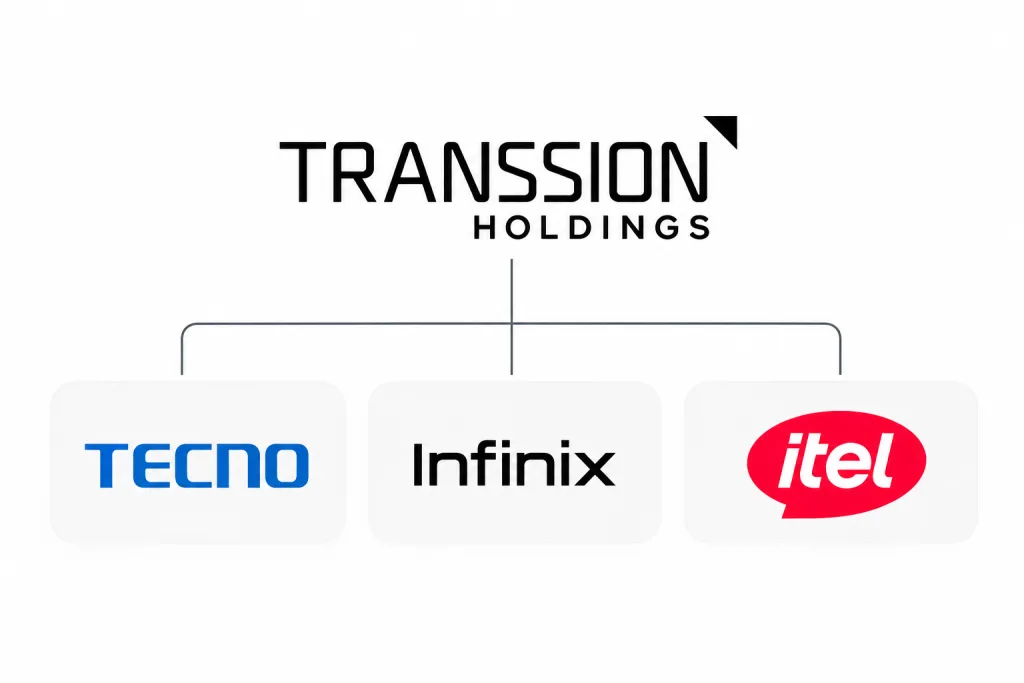
Transsion avoided throwing every buyer under one umbrella brand. itel handled entry-level buyers needing rock-bottom prices. Tecno targeted the broad middle ground with cheap phones that packed solid features. Infinix targeted younger buyers wanting slicker designs, faster chips, and gaming performance.
This setup let them hit multiple price points without making every phone look identical. It remains useful now because market needs vary wildly across the region. A first-time buyer counting every penny has completely different needs than a young worker in Lagos, Johannesburg, or Nairobi looking for 5G, sharper cameras, and fast speeds.
Distribution became a competitive weapon
Transsion built a distribution network that functioned like a hidden engine. Getting phones into actual buyers’ hands required going way beyond shopping malls or big electronics chains. Transsion partnered directly with local wholesalers, neighborhood shops, and street-market vendors across regional hubs. In places like Ghana, they relied on multi-tier distribution networks to push inventory straight into small, informal retail stalls where everyday consumers actually shop.
The World Bank noted that Transsion kept prices low by tailoring supply chains and sales operations directly to local demand. They trimmed overhead, kept inventory moving, and made selling ultra-cheap smartphones profitable.
After sales created another layer of trust
Carlcare gave Transsion a huge edge over low-cost rivals. Buying a cheap smartphone is one thing; keeping it running is what builds trust. Transsion set up Carlcare to handle repairs and support for Tecno, Infinix, and itel. Today, that network covers over 2,000 service points worldwide, counting partner shops. In Nigeria, Carlcare runs dedicated repair hubs, including a massive flagship facility in Ikeja, Lagos. When a screen cracks or a battery dies, buyers have a physical shop to visit. That post-sale presence gives Transsion a lasting connection with customers that rival budget brands rarely match.
Transsion Is Still Dominant, But the Market Has Changed
Transsion entered 2026 holding 47 percent of Africa’s smartphone market, posting a 4 percent shipment bump early in the year while Honor surged with a 101 percent leap. But the broader market quickly soured. Rising memory component costs drove shelf prices up, squeezing basic models. Counterpoint tracked a 12 percent year-on-year shipment drop in early 2026, while Omdia projected a full-year drop near 26 percent after second-quarter shipments fell 7 percent.
The damage hit sub-$100 devices hardest, with shipments plunging 34 percent in mid-2026. Over the same stretch, the average phone price across the continent jumped from $161 to $202. Budget buyers built Transsion’s empire. Now that rising costs are pricing those exact shoppers out, the company’s biggest advantage is slipping.
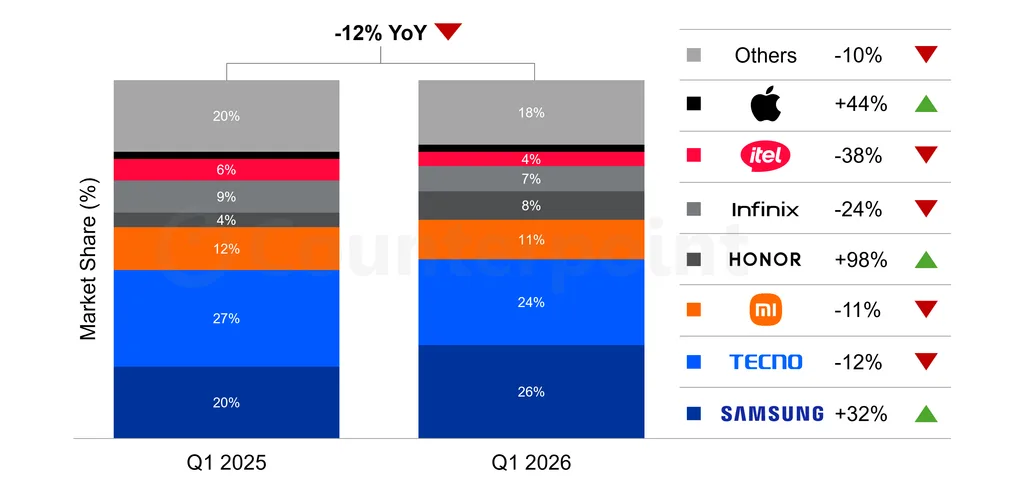
Source: Counterpoint Research Market Monitor Service
Why Keeping the Crown Is Getting Harder
The $100 smartphone is under pressure
For years, sub-$100 smartphones gave millions of Africans their first step into the digital economy. That single device handled everything from mobile banking and WhatsApp to work, social media, and online sales. Now, the math behind those budget phones is breaking down.
Global demand for AI data centers pushed memory component prices way up, hitting DRAM and NAND supplies hard. Omdia estimated that memory components ate up over 64 percent of the total parts cost for phones under $99 in early 2026. That leaves manufacturers no room to absorb extra costs. A buyer eyeing a flagship phone might swallow a price bump for a better camera or a sleek design. A $70 phone enjoys no such luxury; adding even $10 pushes it out of reach for a low-income worker.
To survive this shift, budget phone makers are forced to pivot. Keeping sub-$100 devices alive now depends on phone financing plans, tight inventory control, expanded retail partnerships, and nudging buyers toward slightly higher-value models.
Rivals are learning the Transsion playbook
Transsion built its early success on hyper-localized products and deep distribution networks, but competitors have caught up. Samsung continuously expands its budget-friendly Galaxy A series, Xiaomi holds a major presence across emerging markets, and brands like Oppo tailor their regional sales setups. Meanwhile, Honor posted a 101 percent shipment surge early in 2026 by targeting devices priced above $300. That higher-tier focus shields Honor from the component cost spikes wrecking the ultra-cheap device segment.
Samsung enjoys a similar cushion, holding strong in the $150 to $299 price range where buyers can stomach mild price increases. This leaves Transsion squeezed from both sides. At the bottom, rising part costs undercut its low-price edge. Higher up the price ladder, agile rivals are snapping up consumers ready to pay a bit more for better specs.
Consumers are moving up
African buyers are not walking away from budget phones, but their expectations are changing. Once someone lives with a basic smartphone for a year or two, their standards jump. They want sharper cameras, extra storage, smoother displays, 5G connections, and enough processing power to handle daily gaming without lagging. For Transsion, that evolving demand creates room to expand, paired with a serious customer retention test.
The company has to convince someone who started on an entry-level itel or Tecno to spend extra on an upgraded Tecno or Infinix model. That transition is where the fight lives, because Samsung, Honor, and Xiaomi are targeting those exact same upgrading buyers.
What Transsion Must Do to Keep Winning
Move customers upward without abandoning affordability
Transsion does not have to walk away from its budget base. It simply needs to build a clearer path up its product ladder. That means giving users clear reasons to step up from a basic itel to a mid-range Tecno, then eventually toward a flagship Infinix.
Financing plays a massive role in making that shift work. When high upfront costs block a direct sale, monthly payment plans break down the barrier to a better device without forcing brands to strip specs just to hit an unrealistic sticker price. Market analysts at Omdia point to phone financing as a key tool for keeping mobile internet accessible as device prices rise across the continent.
Make software and AI part of the value proposition
Hardware specs won’t carry the load on their own. Buyers pay far more attention to software stability, camera processing, security updates, and daily performance than they used to. Transsion already sells laptops, smart TVs, earbuds, and wearables alongside its phones. The real test is tying those devices into a unified setup. A smooth device ecosystem keeps users locked in, making them far less likely to jump ship for a cheaper phone.
Smart software features fit into this strategy, provided they serve a clear purpose on budget chips. The goal lies in pinpointing functions that deliver daily value to African consumers, not offering watered-down high-end features.
Invest further in local manufacturing
Expanding assembly plants gives Transsion an edge beyond simple labor costs. Building devices closer to buyers builds supply chain flexibility, creates local employment, and builds goodwill with regional governments. Local factories also help cushion the impact of volatile import tariffs and currency fluctuations.
Local assembly does not wipe out every cost pressure, since core components like memory and processors still depend on global supply networks. Even so, regional manufacturing gives Transsion crucial operational flexibility when global trade conditions turn unpredictable.
Defend Africa while expanding elsewhere
Transsion maintains a substantial footprint beyond Africa, holding strong positions across South Asia, Southeast Asia, the Middle East, and Latin America, particularly in Pakistan, Bangladesh, and the Philippines.
Spreading operations across multiple regions protects the business when a single market slows down. Still, Africa remains the anchor. Local conditions vary too widely for a copy and paste expansion strategy. While African operations offer useful foundation lessons, winning in Latin America or Southeast Asia depends on building strategies custom tailored to each market’s specific economic reality.
Keep listening to the customer
Transsion won its market share by spotting details global rivals missed, not just by undercutting prices. Maintaining that position requires keeping the same sharp focus on user behavior.
The next wave of African buyers brings higher expectations than the users who picked up early Tecno and itel models. Today’s consumers look closely at camera processing, software updates, data protection, and connected digital services. Transsion retains its edge only if it catches these shifting priorities early and adjusts its products fast.
Legal Battles Signal A New Phase Of Risk
The legal friction with Ericsson shows how high the stakes get as a manufacturer scales up. While a global settlement put an end to lawsuits across Nigeria, India, and Brazil, the dispute highlighted a clear turning point for Transsion.
Early growth in African markets operated under the radar of major patent holders, but selling higher-end hardware on a global scale changes the operational math. Securing licenses, funding internal research, and managing patent risks are now permanent line items in Transsion’s long-term business strategy.
Adapting to Africa’s Changing Tech Market
Transsion can maintain its dominance, but doing so demands a completely different approach from the playbook that built its early empire. On an optimistic trajectory, the company evolves from a budget phone seller into a broader technology provider. Its portfolio already spans distinct price points, backed by an extensive distribution network, robust Carlcare service centers, and growing regional assembly plants.
The alternative scenario comes with operational risks. If memory inflation and supply chain costs keep driving up component expenses, the sub-$100 phone market will continue shrinking. As consumers gradually move toward higher-value devices, Transsion’s massive volume advantage loses momentum. Competitors with better premium reputations stand to capture these upgrading buyers. Honor continues its steady climb, Samsung protects the mid-range tier, and Xiaomi and Oppo refine their regional execution. Transsion would then face a difficult balancing act: raising prices enough to protect operating margins while keeping smartphones accessible enough to retain its original customer base.
The future of African smartphone markets will not be determined by who builds the absolute lowest-cost device. That strategy faces diminishing returns across the industry. Rising input costs, higher retail prices, and changing buyer habits are reshaping the market’s basic economics. Industry estimates from Omdia point to a 26 percent decline in total African smartphone shipments in 2026, with the sub-$100 segment taking the steepest loss. Transsion retains a massive advantage because it understands how African consumers buy and use technology. The primary challenge is translating that local insight into its next generation of products.
The central lesson of Transsion’s rise remains unchanged: African consumers did not need a watered-down global smartphone; they needed devices built around local realities. Its future depends on identifying those shifting realities faster than its rivals.
Sources:
- Market data and outlook sourced from Omdia, 2026.
- Distribution strategy sourced from World Bank research.
- Q1 2026 market data sourced from Counterpoint Research.
- Patent litigation and settlement sourced from Ericsson, 2026.