
There is a paradox sitting at the heart of Nigeria’s financial system, and the numbers make it impossible to ignore. Digital payment volumes have surged more than 270% over the past five years. Millions of Nigerians now send money through USSD codes, tap through mobile apps, and transact daily at POS terminals in markets, bus stops, and barbershops. By every adoption metric, the cashless vision appears to be working.
And yet, total currency in physical circulation actually rose by 4.6% in 2025. ATM withdrawals across the country reached ₦36.34 trillion in the first half of that year alone. These two realities do not contradict each other. They explain each other. Nigerians are using digital tools because they often have no choice, but they are holding onto cash because the system has not yet earned the right to be their only option.
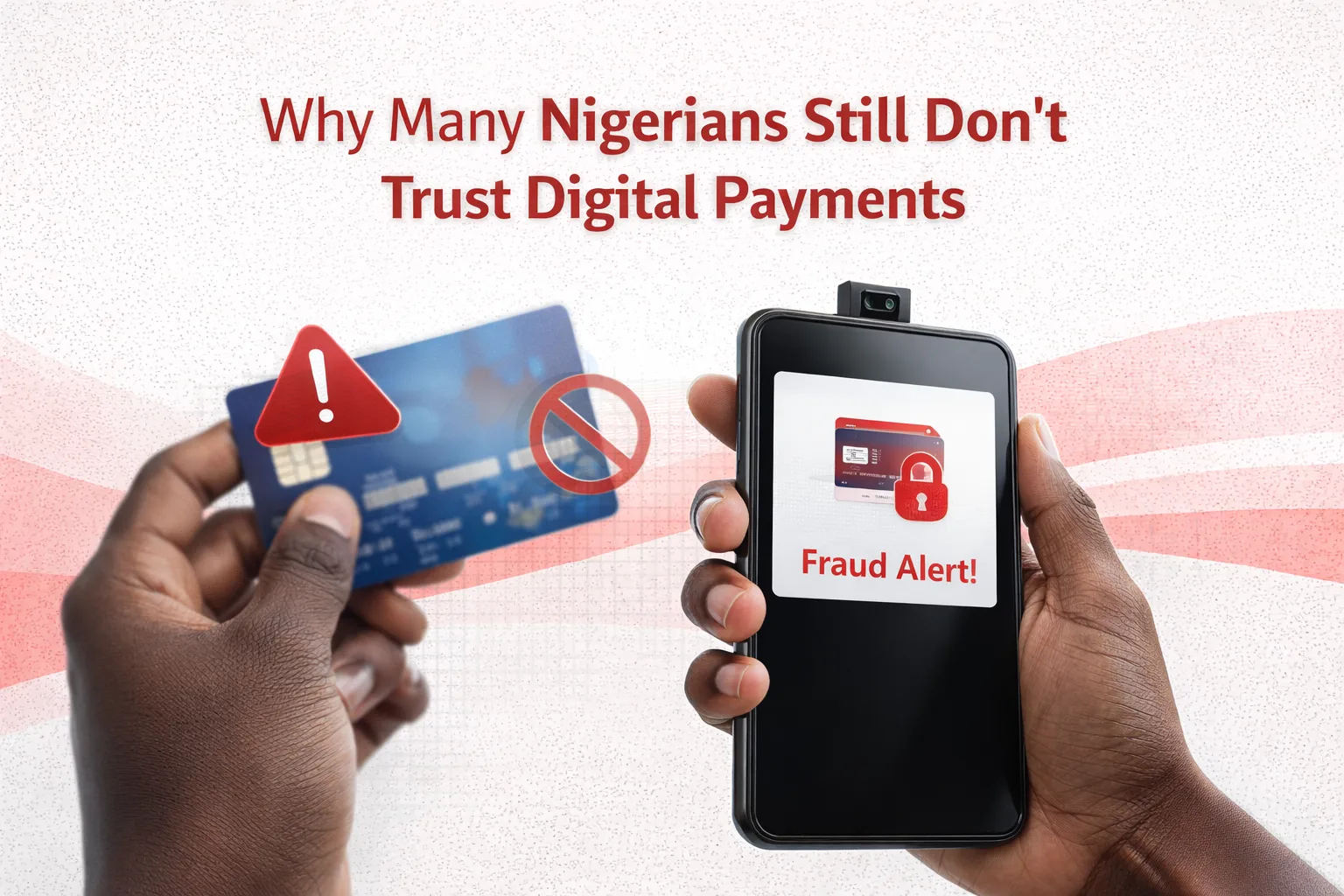
Fraud, Fear, and Digital Finance
In 2025, Nigerian financial institutions lost ₦25.85 billion to electronic payment fraud. That figure is significant even in isolation, but its context makes it more telling. It came after a 51% drop from the ₦52.26 billion lost in 2024. Fraud is declining. The fear of fraud is not.
The tactics responsible for most of these losses are not abstract. Social engineering, SIM swap attacks, and phishing remain the dominant methods through which Nigerians lose money to bad actors. They work because they exploit trust: trust in a phone number, trust in a message that appears to come from a bank, trust in a voice that sounds authoritative. When trust itself becomes the attack surface, the rational response is to extend less of it.
There is also a specific fear that does not appear in fraud statistics but circulates loudly in everyday conversation: insider collusion. The suspicion that bank staff may sometimes facilitate fraud is not a conspiracy theory. It is a lived cultural reality for many Nigerians who have had money disappear without a convincing explanation from their institution. Once that suspicion takes root, no amount of marketing can uproot it.
Infrastructure Failures and the Trust Deficit
Even setting fraud aside, the physical infrastructure supporting digital payments in Nigeria remains inconsistent in ways that push users back toward cash at the moments that matter most.
In early 2025, thousands of fiber optic cable cuts, caused by construction activity and vandalism, triggered widespread network outages across the country. These were not minor inconveniences. They disrupted banking services, slowed mobile transactions, and in some areas made digital payments temporarily impossible. The cuts were eventually repaired, but the damage to confidence is harder to fix than cables.
By December 2025, internet penetration in Nigeria reached 68.3%. That figure sounds promising until you consider that the government’s own 70% broadband target was missed. A significant portion of Nigerians, particularly in rural areas, still rely on 2G or 3G networks. These connections are too unstable for consistent mobile banking. They produce the experience that Nigerians dread most: a transaction that appears to succeed on one end while failing silently on the other.
The Personal Cost of System Failures
According to the Enhancing Financial Innovation and Access survey (EFInA), only 16% of Nigerian adults were classified as financially healthy in late 2023. That was a sharp decline from 28% in 2020. The remaining 84% of adults had, at some point in 2023, run completely out of money.
This statistic reframes the entire conversation about digital payment adoption. Trust in a financial system is not just a psychological or technical question. It is an economic one. When the margin between stability and crisis is razor-thin, the cost of a failed transaction or a delayed reversal is not just frustration. It can mean a missed meal, an eviction, a child kept home from school.
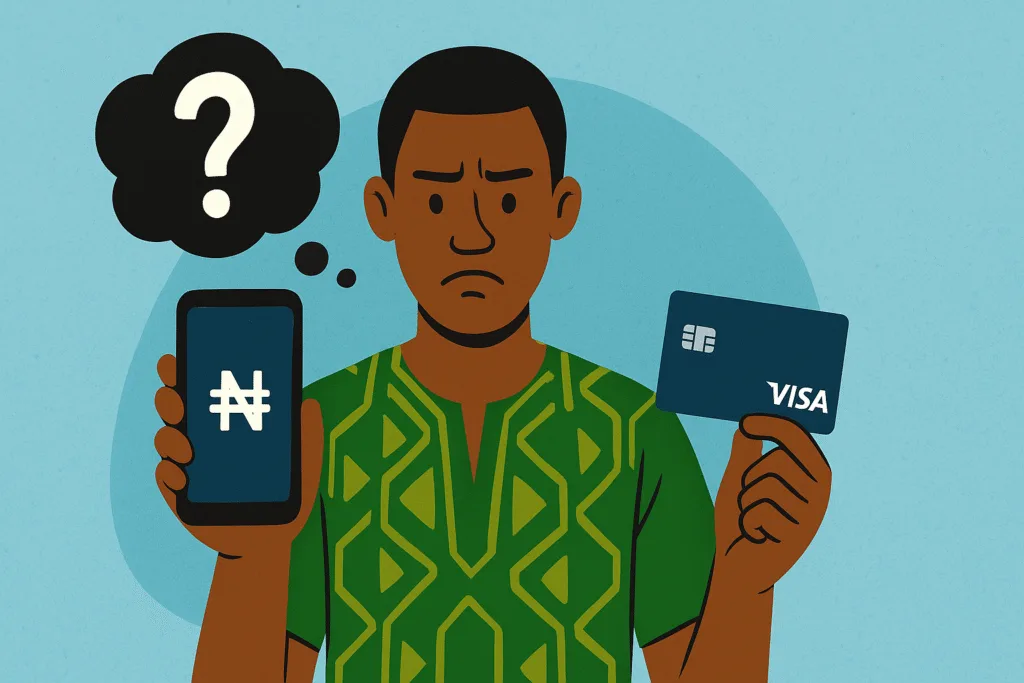
This is why even Nigerians who use mobile apps daily often keep a portion of their money in physical notes. It is risk management practiced by people who cannot afford to be wrong.
Cash Is Not Retreating. It Is Being Reinforced.
One of the most important data points in this story is the one that tends to get overlooked: total currency in circulation rose by 4.6% in 2025. In a year when digital transaction volumes continued to grow, physical cash also grew. These two things grew together.
The explanation is not complicated. Nigerians are using digital transfers for large or long-distance transactions, where the convenience outweighs the risk. But for daily life, for the market, the bus fare, the suya at the roadside stand, cash remains the preferred medium. ATM withdrawals of ₦36.34 trillion in the first six months of 2025 suggest that for many Nigerians, the primary function of a digital bank account is still to convert digital money back into physical notes.
This pattern reveals something important about how trust actually works in practice. It is not all-or-nothing. Nigerians have not rejected digital payments. They have assigned them a specific role in their financial lives, and kept cash for the role that digital payments have not yet proven they can fill consistently.
When Things Go Wrong, There Is Often No One to Call
Between 2023 and 2024, the Central Bank of Nigeria (CBN) received and resolved approximately 76.5% of nearly 20,000 consumer complaints. That is a meaningful number of resolved cases. But the 23.5% that went unresolved also represents thousands of Nigerians who filed a complaint, waited, and were left without a resolution. Many of them told their stories to family, friends, and community members.
Unresolved financial complaints do not stay private. They become cautionary tales that travel through social networks and shape the decisions of people who have never personally experienced a failed transaction. In a country where trust in institutions is already fragile, each unresolved case multiplies into dozens of people who decide not to fully commit to digital payments.
The CBN’s consumer protection framework has improved, but the lived experience of many Nigerians in rural and peri-urban areas is that recourse is slow, distant, and uncertain. And uncertainty, in financial services, is another name for distrust.
Legacy Policies and the Trust Deficit
The 2023 naira redesign remains one of the most instructive episodes in recent Nigerian financial history. The Central Bank’s decision to simultaneously withdraw old notes and restrict cash availability was intended to push Nigerians toward digital channels. It succeeded in forcing the behavior, but not in building the confidence.
When millions of Nigerians turned to digital payments during the cash shortage, the system struggled under the load. Networks slowed. Transactions stalled. Traders began rejecting bank transfer alerts because they had seen too many go unconfirmed. The very pressure test that should have demonstrated the readiness of Nigeria’s digital infrastructure instead exposed its limits to an audience of tens of millions, many of whom were using digital payments seriously for the first time.
The lesson many Nigerians took from that period was not that digital payments could handle a crisis. It was that digital payments could fail precisely when the stakes were highest. That lesson is sticky.
What the Numbers Are Really Saying
Taken together, the data tells a story that is more textured than a simple narrative of adoption or resistance. Nigerians are not avoiding digital payments. They are using them at record volumes. But they are holding cash in parallel, filing complaints when things go wrong, withdrawing from ATMs at extraordinary rates, and carrying the memory of a crisis in which the system they were told to trust cracked under pressure.
The truth is that Nigeria is on a journey. Building trust in digital payments will take time and visible improvements. People need to see fewer failed transactions, faster reversals, better fraud prevention, and excellent customer service. Trust cannot be forced. It is earned through daily experiences. For many Nigerians, digital payments will only become the default when they work as smoothly and reliably as cash. Until then, cash will remain king, but the future is clearly digital, waiting to be embraced when confidence catches up.
Sources
- Nigeria Inter-Bank Settlement System (NIBSS) — Electronic Fraud Figures, 2024 and 2025
- Enhancing Financial Innovation and Access (EFInA) — Financial Health Survey, 2020 and 2023
- Central Bank of Nigeria (CBN) — Currency in Circulation Report, 2025; Consumer Complaints Data, 2023–2024
- NIBSS — ATM Withdrawal Transaction Data, H1 2025