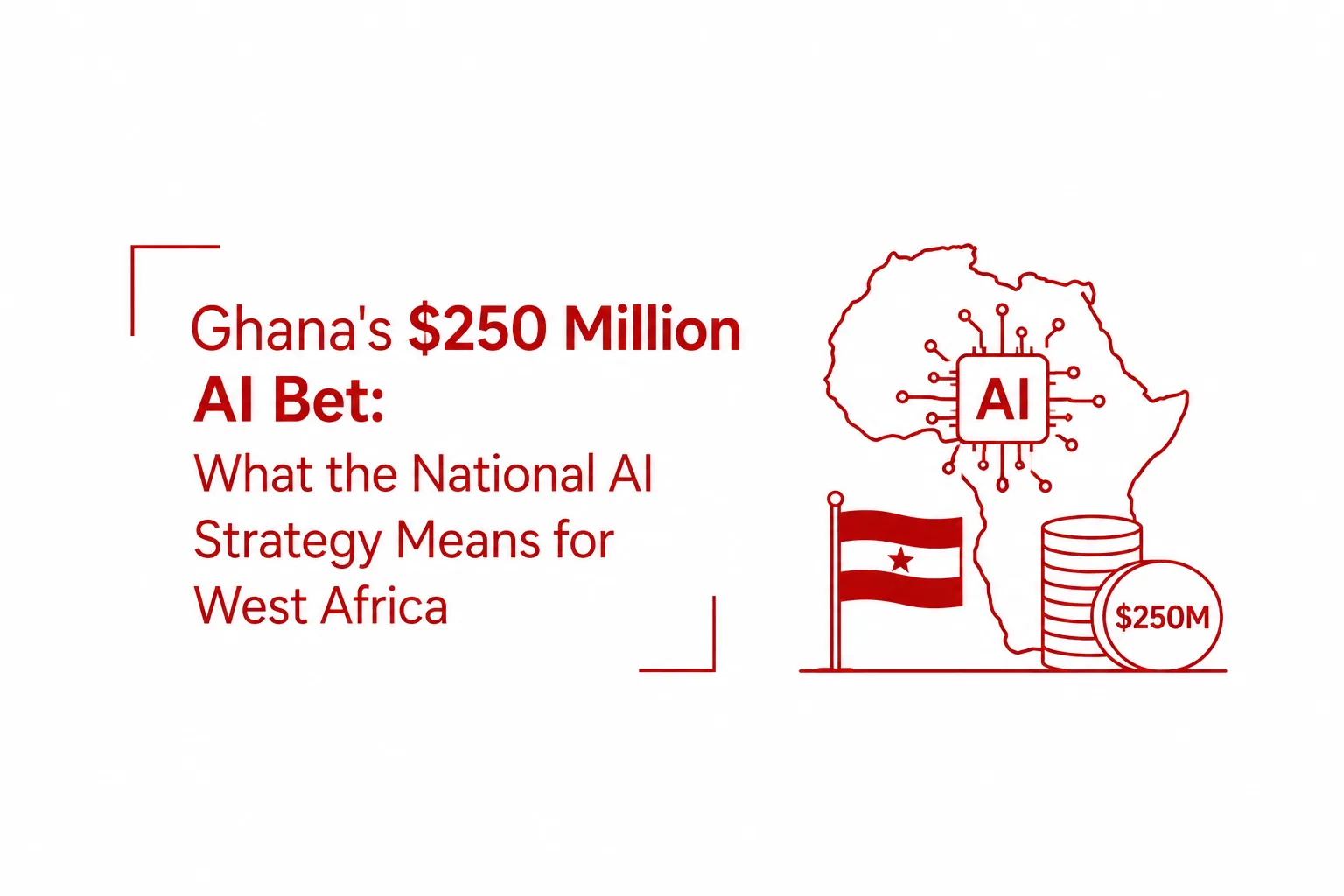

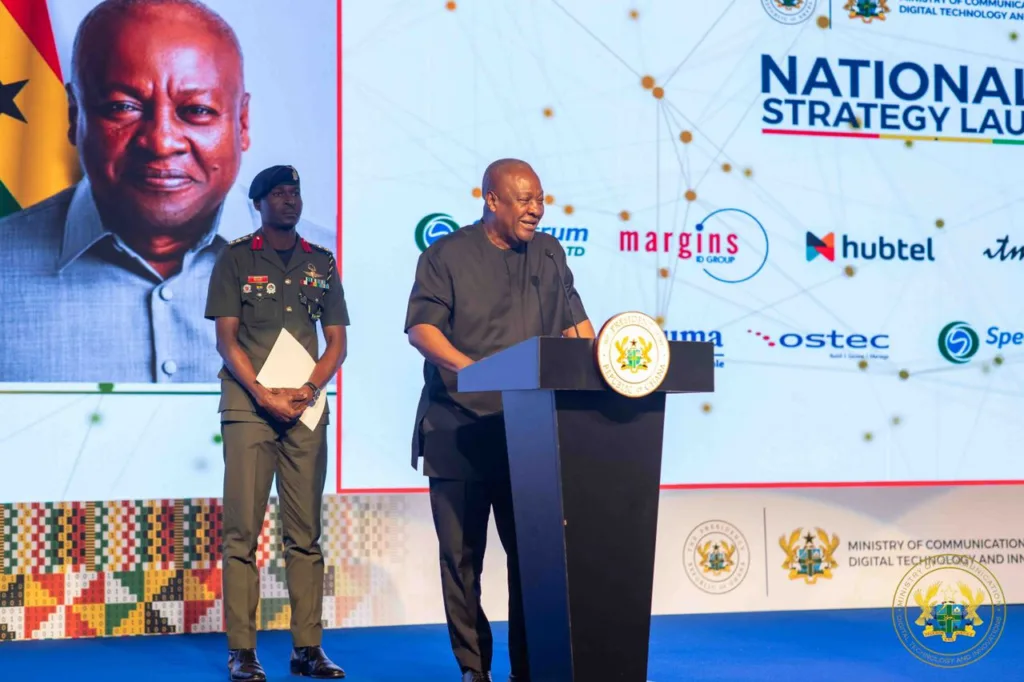
Ghana launched its first National AI Strategy on Friday, April 24, 2026, setting out a ten-year roadmap that commits significant public capital to building domestic AI capacity. President John Dramani Mahama presided over the launch in Accra, framing the strategy as a deliberate departure from passive technology consumption toward active participation in designing and governing AI systems. The ten-year window runs from 2025 to 2035, and the financial commitments attached to it are among the most detailed any West African government has put on record for a technology policy initiative.
The Financial Architecture
The centrepiece infrastructure announcement is a $250 million AI Computing Centre to be built in Accra. The facility is intended to provide high-performance computing capacity for local startups and researchers, removing the dependency on expensive foreign cloud infrastructure that has historically constrained AI development across the continent.
Alongside the computing centre, the government has established a National AI Fund seeded at GHC 5 billion for the first phase covering 2025 to 2030. That figure is projected to scale to GHC 15 billion by 2035. The stated ambition for the fund is to catalyze GHC 200 billion in private sector investment over the decade, with AI-driven industries targeted to contribute GHC 500 billion to Ghana’s GDP by 2035.
Legal Framework: Emerging Technologies Bill
A recurring weakness in African technology policy has been the gap between stated ambition and enforceable regulation. Ghana’s strategy addresses this directly through an upcoming Emerging Technologies Bill designed to move AI governance out of policy documents and into law.
The Bill will establish Regulatory Sandboxes, formal legal structures that allow fintech and health-tech companies to test AI products under relaxed rules before committing to full market compliance. This mechanism gives early-stage companies room to iterate without the full weight of regulatory exposure before their products are ready for it.
The Bill also formally establishes the Responsible AI Authority, an independent body initially housed within the Data Protection Commission. Its mandate covers ethical compliance oversight and the prevention of algorithmic bias across AI systems deployed in Ghana. A further provision protects workers through a legal framework ensuring AI deployment augments human capability and does not eliminate jobs without structured transition support.
The Communications Minister, Samuel Nartey George, described the strategy at the launch as reflecting “the collective intelligence of a nation,” adding that the government approached AI from the outset as a national development issue across governance, education, health, agriculture, and the economy, not a narrowly technical one.
Language, Culture, and Data Sovereignty
One of the more substantive components of the strategy is its treatment of cultural and linguistic sovereignty, an area where African AI policy has historically been thin.
Ghana has announced a dedicated Natural Language Processing Centre of Excellence focused on building AI capability in Ghanaian languages. The problem this addresses is well-documented. Large language models trained predominantly on English-language data perform poorly in local language contexts, producing outputs that miss cultural nuance, legal specificity, and everyday conversational patterns.
To anchor this work in local data, the government has set a target of curating one trillion tokens of indigenous Ghanaian data by 2030. The dataset is intended to train AI models that understand Ghanaian law, culture, and trade on their own terms.
Sector Applications
The strategy identifies healthcare, agriculture, and public administration as its three priority deployment sectors.
In healthcare, the focus is on AI-driven diagnostics for rural clinics operating without specialist doctors, a use case with direct relevance across Ghana’s under-served regions where specialist physician density remains low.
In agriculture, the government plans to deploy precision farming tools that use satellite data to help smallholder farmers predict weather patterns and improve crop yields. In public administration, the Ghana Revenue Authority is targeted for AI integration to automate domestic revenue mobilisation and reduce manual filing errors.
President Mahama described the strategy at launch as a social contract. The human capital component of that contract is the AI Ready Ghana programme, which targets training one million young Ghanaians in AI-related skills by 2033. The programme is designed to align workforce development with the technical job creation the strategy expects its infrastructure and regulatory investments to produce.
The launch brought together ministers from Interior, Foreign Affairs, Education, and Fisheries, alongside industry, academic, and development partner representatives.
What This Means for West Africa
Ghana’s strategy arrives at a moment when several African governments are formalising their positions on AI governance. For West Africa specifically, the $250 million computing centre in Accra has regional implications. If the facility provides open or subsidised access to researchers and startups from neighbouring countries, it could function as shared regional infrastructure. That possibility has not been formally committed to, but the logic of regional AI infrastructure sharing is one that development partners and regional bodies are increasingly raising.
Ghana has put a detailed and costed framework on the table. The decade ahead will determine how much of it translates from policy into operating infrastructure.