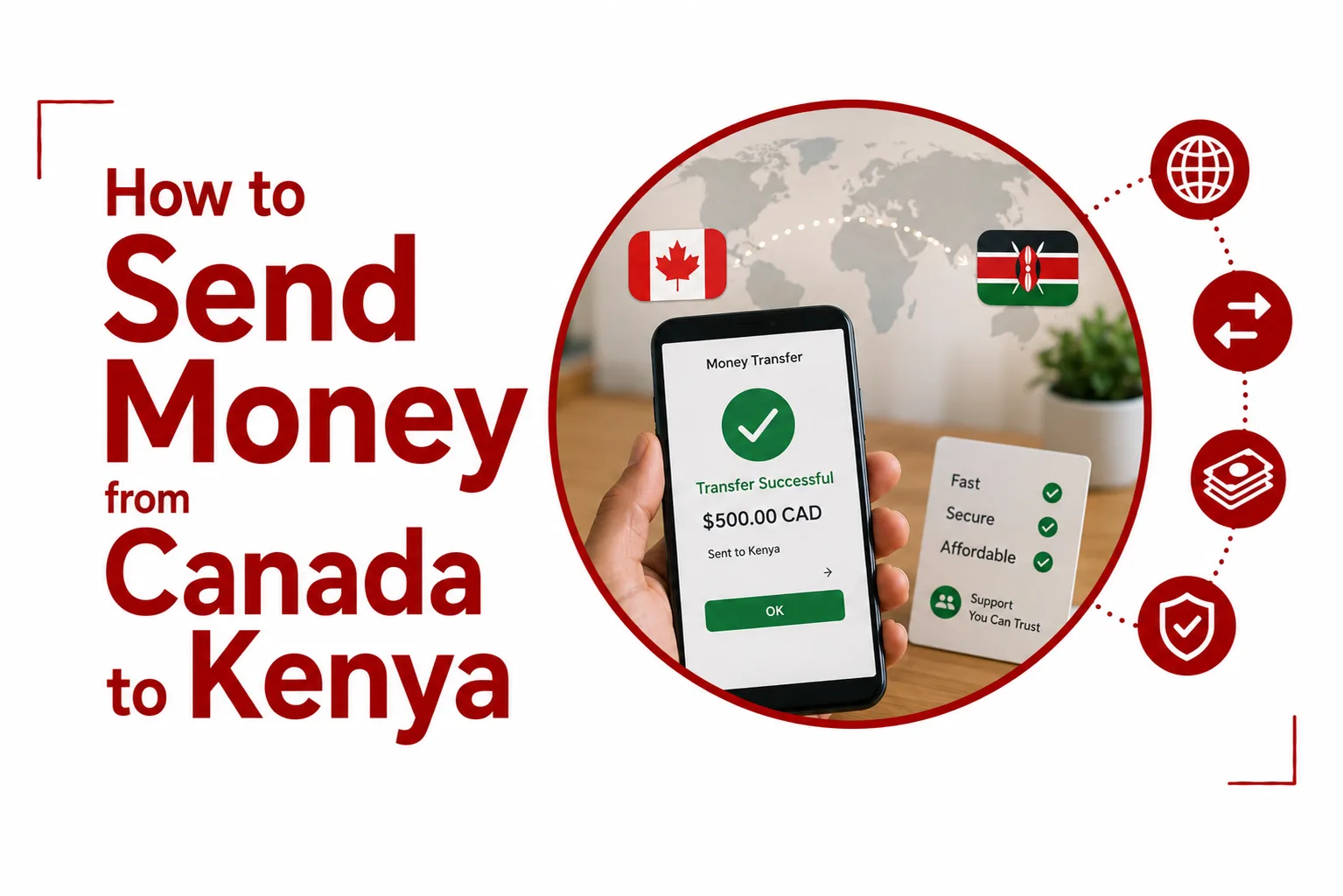

Send money from Canada to Kenya without the old frustrations of standing in long bank lines or paying excessive fees. Modern digital platforms allow you to transfer funds directly from your phone, with many options offering zero fees and near-instant delivery to M-Pesa wallets. These services simplify supporting family members, paying school fees, or managing business transactions by making the entire experience fast and convenient.
Informed decisions about which platform to use can save both time and money. Some offer better exchange rates. Others specialize in instant M-Pesa transfers. A few charge no fees at all under certain conditions. A little bit of research helps you protect your hard-earned money from being eaten up by greedy middlemen. Let’s break down exactly how to send money from Canada to Kenya, which platforms work best, and how to get the most value from every transfer.
Quick Links
Should you Still use a Traditional Bank for International Transfers?
Canadian banks will happily process your money transfer to Kenya, but they’ll charge you heavily for the privilege. Most banks use exchange rates that are several percentage points worse than the actual market rate, which means you’re losing money before any stated fees even apply. On top of poor exchange rates, banks charge transfer fees depending on the amount and destination. When you combine a bad exchange rate with high fees, you can easily lose 5 to 8 percent of your transfer amount.
Processing times are another problem. Bank transfers to Kenya often take 3 to 5 business days, which is unacceptable when someone needs money urgently for medical bills, school fees, or emergencies. Specialized money transfer apps have disrupted this outdated system by offering better rates, lower fees, and faster delivery.
What Are the Best Apps for Sending Money to Kenya from Canada?
Several platforms have emerged as the top choices for Canadians sending money to Kenya. Each has particular strengths depending on your priorities.
1. Pesa
The zero-fee model adopted by Pesa makes it a highly attractive option, as it applies to every transfer regardless of size. This is significant because most competitors charge fees on smaller transfers. The platform provides instant or same-day delivery, which makes it ideal for urgent situations. When your family member needs money for an emergency, waiting days isn’t an option. Pesa’s speed matches the urgency.
Transfers can go directly to M-Pesa mobile wallets, which is a major advantage because M-Pesa dominates money transfers in Kenya. Recipients can access funds immediately and use them for everything from paying bills to withdrawing cash at agents across the country.
2. RemitBee
RemitBee offers an attractive fee structure: zero fees on transfers over $500 CAD when you pay using Interac e-Transfer, EFT, or bill payment. For transfers under $500, there’s a flat fee of just $2.99 CAD. This makes RemitBee excellent for regular larger transfers. If you’re sending monthly support to family, the amounts usually exceed $500, which means you’re essentially transferring money for free except for exchange rate differences.
RemitBee supports delivery to M-Pesa wallets and Kenyan bank accounts. The platform is well-regarded for its reliability and customer service, with good reviews from Canadian users sending money across Africa.

3. Remitly
Remitly frequently offers special exchange rates and no fees for first-time customers, making it an excellent choice if you’re new to digital money transfers or comparing platforms. The app supports multiple delivery methods: M-Pesa transfers, bank deposits, and cash pickups. This flexibility is useful if different recipients prefer different receiving methods. One family member might want M-Pesa while another prefers direct bank deposit.
Remitly has built a reputation for transparency, showing exactly how much the recipient will get in Kenyan shillings before you confirm the transfer. There are no hidden surprises.
4. WorldRemit
WorldRemit specializes in mobile money transfers, which makes it particularly well-suited for sending to M-Pesa. Many WorldRemit transfers arrive within minutes, offering the speed Kenyans have come to expect. The platform also supports bank transfers and cash pickups for recipients who don’t use M-Pesa, though mobile wallet delivery is clearly their strength. WorldRemit has been operating for years and has established trust among African diaspora communities in Canada. The app is straightforward to use, with clear pricing and delivery time estimates.

5. Western Union
Western Union remains relevant primarily because of its extensive cash pickup network. With thousands of agent locations across Kenya, recipients can collect money even in rural areas where banking infrastructure is limited. The platform now offers digital transfers to bank accounts and mobile wallets in addition to traditional cash pickup. Online transfers can handle up to 7,500 CAD, which covers most personal transfer needs.
Western Union’s fees tend to be higher than newer competitors, but the trade-off is reliability and accessibility. For recipients in remote areas or those who prefer physical cash, Western Union’s agent network is unmatched.
6. Wise (formerly TransferWise)
Wise has built its reputation on transparency and fair pricing. The platform uses the mid-market exchange rate, which is the real rate you see on Google or financial news sites, not an inflated rate designed to generate profit. Wise shows all fees upfront before you confirm the transfer. What you see is exactly what you pay, with no hidden charges appearing later.
The platform works well for large bank-to-bank transfers or bank-to-M-Pesa transfers. Processing times are typically 1 to 2 business days, so Wise isn’t the fastest option, but it’s one of the most economical for larger amounts where saving on exchange rates makes a real difference.
7. LemFi
LemFi has emerged as a top-tier choice for the Kenyan diaspora by offering a 100% fee-free model for all transfers from Canada. Users fund their transactions via Interac e-Transfer, and the platform delivers funds almost instantly to M-Pesa wallets or Kenyan bank accounts.
LemFi is particularly popular because it provides a “multi-currency wallet,” allowing you to hold both CAD and KES within the app. This feature gives you the flexibility to convert money when exchange rates are favorable and send it later. While there are no transaction fees, the service earns revenue through a small markup on the exchange rate.
How Does M-Pesa Actually Work?
M-Pesa’s widespread use across the country means that sending funds directly to a mobile phone is often more convenient than using a traditional bank. M-Pesa is a mobile money platform operated by Safaricom that allows users to store money on their phones, send money to others, pay bills, buy goods, and withdraw cash at thousands of agents across Kenya. It’s not just a payment system. It’s essentially replaced traditional banking for millions of Kenyans.
When you send money to a Kenyan M-Pesa number, the recipient receives an SMS notification confirming the deposit. The money is instantly available in their M-Pesa wallet. They can then transfer it to their bank account, use it to pay bills, send it to someone else, or withdraw cash at any M-Pesa agent. This system is incredibly convenient because M-Pesa agents exist everywhere in Kenya, from Nairobi to the smallest rural villages. Your recipient doesn’t need to travel to a city or wait for bank hours. They can access their money almost immediately at a local shop or kiosk.
For Canadians sending money, M-Pesa transfers are the fastest and most convenient option in most cases. Just make sure you have the recipient’s correct Safaricom phone number, as that serves as their M-Pesa account identifier.
What Information Do You Need to Send Money from Canada to Kenya?
The exact information required varies slightly by platform and delivery method, but generally you’ll need:
For M-Pesa transfers:
- Recipient’s full legal name (matching their ID)
- Recipient’s Safaricom mobile phone number (this is their M-Pesa account)
For bank transfers:
- Recipient’s full legal name
- Recipient’s bank account number
- Bank name and branch
- Bank’s SWIFT code (for international transfers)
For cash pickup:
- Recipient’s full legal name
- Recipient’s phone number
- Valid government ID that the recipient will present when collecting
Make absolutely certain the name you enter matches the recipient’s official identification exactly. Spelling errors or name variations can cause delays or transfer rejections.
How Long Does It Actually Take to Send Money from Canada to Kenya?
Transfer speed depends on the platform and delivery method you choose.
M-Pesa transfers are usually the fastest. With platforms like Pesa, WorldRemit, or RemitBee, funds often arrive within minutes once your payment is processed. The recipient gets an SMS confirmation and can use the money immediately.
Bank deposits take longer, usually 1 to 2 business days. The funds need to clear through the international banking system before appearing in the recipient’s Kenyan bank account. Some banks are faster than others, with digital banks often processing incoming transfers more quickly than traditional institutions.
Cash pickups are available almost immediately once the transfer is processed, but the recipient has to physically travel to a pickup location during business hours, which adds practical delay time.
The payment method you use in Canada also affects speed. Interac e-Transfers are processed quickly. Funding via bank transfer can add 1 to 2 days to the total delivery time.
What’s the Step-by-Step Process?
Here’s how to actually send money using these platforms:
Step 1: Create an Account
Download your chosen app (Pesa, RemitBee, Remitly, WorldRemit, etc.) from the App Store or Google Play. Sign up using your email address and create a secure password. You’ll provide basic information like your name, address, and phone number.
Step 2: Verify Your Identity
Canadian regulations require money transfer platforms to verify user identities to prevent fraud and money laundering. You’ll need to upload a photo of a government-issued ID, typically your passport or driver’s license. Some platforms also ask for a selfie to confirm you match the ID photo. This verification process usually takes a few minutes to a few hours.
Step 3: Enter Recipient Information
Add your recipient by entering their full name and either their M-Pesa phone number (for mobile wallet transfers) or their bank account details (for bank deposits). Double-check everything before saving. One wrong digit in a phone number or account number means your money goes to the wrong person or gets rejected and delayed.
Step 4: Enter Transfer Amount
Specify how much you want to send. Most apps let you enter either the amount you’re sending in CAD or the amount the recipient should receive in Kenyan shillings. The platform calculates the other amount based on the current exchange rate. Review the exchange rate, fees, and total cost carefully. The app should show exactly how many Kenyan shillings your recipient will receive.
Step 5: Choose Payment Method
Pay using Interac e-Transfer (highly recommended for speed and low cost), debit card, credit card, or bank transfer. Interac e-Transfer is the fastest and most economical option for most platforms. Credit cards typically incur additional fees and are generally not worth it unless you have no other option.
Step 6: Confirm and Track
Review all details one final time, confirm the transfer, and you’ll receive a tracking number. Most apps let you monitor the transfer status in real-time. You’ll get notifications when the money is sent and when the recipient receives it.
What Happens If Something Goes Wrong?
If your transfer is delayed, contact the platform’s customer service immediately. Most issues stem from incorrect recipient information or verification problems that can be resolved quickly. If money goes to the wrong person due to your error in entering information, recovery is difficult but sometimes possible. Contact customer service immediately. The sooner you report the problem, the better the chances of reversing the transaction. Keep all confirmation emails, transaction numbers, and screenshots of transfer details. This documentation is essential for resolving disputes or tracking down delayed transfers.
Whatever platform you choose, verify recipient information carefully, compare rates before each transfer, and keep records of all transactions. Your family in Kenya deserves to receive every shilling you send, not lose money to pointless fees and poor exchange rates.