

Uber is shutting down its ride hailing operations in Nigeria and Uganda, bringing an end to its services in two African markets where it has operated for years. The company announced the decision on September 2, 2026, as part of a broader review of its business priorities and investment focus.
The announcement comes at the same time as Uber’s plan to eliminate about 3,300 corporate positions globally, equal to roughly 10 percent of its workforce. The company is simplifying its corporate structure and directing more resources toward areas it sees as important to future growth, including ride hailing, delivery and autonomous transportation.
For Nigeria, the departure closes a 12 year chapter that began with Uber’s arrival in Lagos in 2014. Uganda is also losing one of its major international ride hailing platforms. Still, this is not an exit from Sub Saharan Africa as a whole. Uber has said its operations in other markets across the region will continue.
In This Article
Uber’s September 2 Exit Announcement
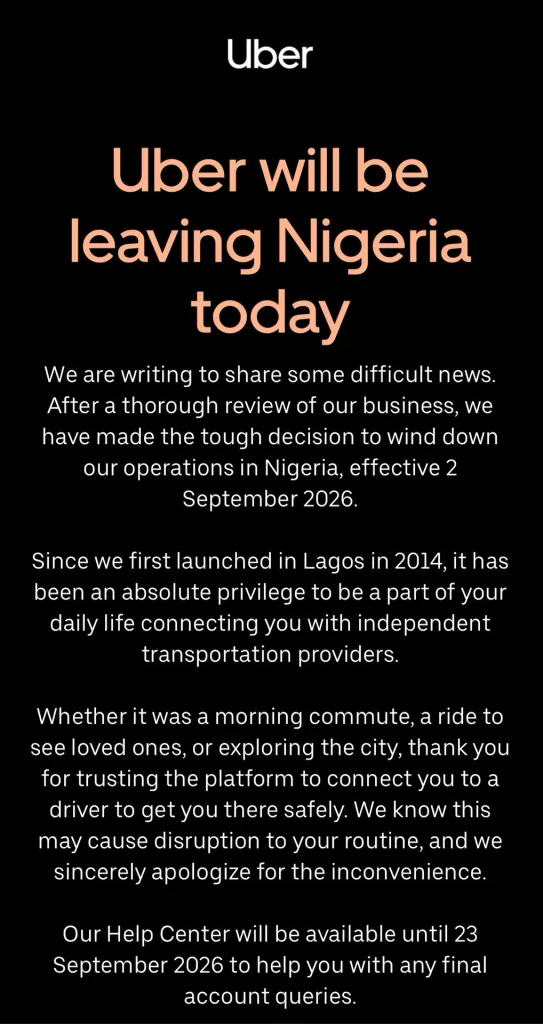
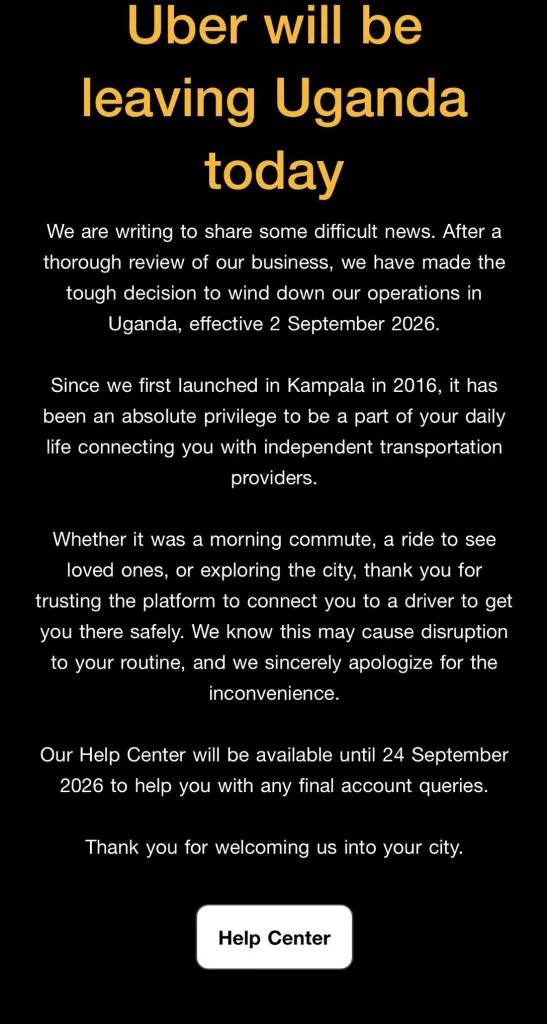
Uber announced on September 2, 2026 that it would discontinue operations in Nigeria and Uganda. The company linked the decision to its evolving business priorities and investment focus across Africa. It has not described the move as a complete withdrawal from the African continent.
For Nigerian customers, support will remain available through September 23, 2026 for final account related issues and balance resolutions. That gives riders time to address outstanding concerns following the shutdown. Uber’s departure from Nigeria ends a presence that began in Lagos in 2014. Over the following years, the platform became one of the major names in Nigeria’s app based transportation market.
The company is making a similar withdrawal in Uganda, while retaining its presence in other Sub Saharan African markets. This makes the move a targeted reduction in its African footprint, not a continent wide shutdown.
The 3,300 Global Job Cuts
The Nigeria and Uganda announcement arrived alongside Uber’s decision to cut approximately 3,300 corporate jobs, representing about 10 percent of its global workforce. Uber had about 34,000 employees globally at the end of 2025. The restructuring is the company’s largest workforce reduction since the COVID 19 pandemic.
The changes are focused heavily on organisational structure. Uber plans to reduce management layers, combine some teams and cut back on small teams with limited reporting structures.
The company also plans to reduce fully remote positions to about 1 percent of its workforce while concentrating more employees around major company hubs. The stated goal is to create a simpler organisation with faster decision making and clearer responsibility. The savings generated by the restructuring are intended for growth, innovation and future technology investments.
Autonomous transportation is an important part of that strategy. Uber plans to put more than $10 billion into robotaxi related initiatives over the coming years, as competition in autonomous transportation grows.
That broader corporate shift provides important context for the Nigeria and Uganda exits. However, it would be inaccurate to claim that Uber has specifically said it is leaving these two countries to fund robotaxis. The company has instead described the African exits in terms of changing priorities and investment focus.
Economic Conditions in Nigeria and Uganda
Nigeria and Uganda operate in economic environments that can create challenges for transportation companies. Currency movements can affect the value of locally generated revenue when it is converted into US dollars. In Nigeria, the naira has experienced substantial depreciation in recent years, while Uganda’s shilling has also moved against major international currencies.
Fuel costs are another important part of the ride hailing equation. Drivers have to cover fuel, vehicle maintenance, insurance, financing and other operating expenses. When those costs increase, maintaining affordable fares while keeping driving economically worthwhile becomes more difficult.
Inflation can also affect passenger demand. As household expenses increase, some consumers may reduce nonessential trips or become more price sensitive. These conditions are relevant to understanding the markets in which Uber operates, but they should not be presented as confirmed reasons for the company’s decision to leave Nigeria or Uganda.
Competition in Nigeria and Uganda
Uber is also leaving markets with established local and international competitors. In Nigeria, Bolt and inDrive are major names in app based transportation. Their presence means Uber has had to compete for both passengers and drivers in a market where price remains an important consideration.
inDrive uses a model that allows passengers and drivers to negotiate fares, giving it a different approach from conventional platform pricing. Bolt has also built a substantial ride hailing presence in Nigeria. Competition does not by itself prove that Uber’s Nigerian operation was unprofitable or that it caused the exit. It is better understood as part of the commercial environment in which Uber made its decision.
Uganda poses another distinctive challenge because motorcycles play a major role in urban transportation. In Kampala, boda bodas are an important part of everyday mobility, and platforms such as SafeBoda have built services around that local transportation pattern. This gives locally focused companies an advantage in understanding how people move around the city, how motorcycle transportation works and what riders expect from a mobility platform.
Again, Uber has not identified Bolt, inDrive, SafeBoda or any other individual competitor as the reason for its withdrawal.
What Uber’s Exit Means for Drivers
The immediate effect for drivers is the loss of Uber as a source of trip requests. Drivers who used Uber alongside other ride hailing platforms can continue working through services that remain available in their markets. Those who depended heavily on Uber will have to consider other platforms or alternative sources of income.
The departure could increase competition among other ride hailing companies as they try to attract drivers who previously worked with Uber. Platforms with existing operations in Nigeria and Uganda are now positioned to capture some of that displaced supply.
What Uber’s Exit Means for Passengers
Passengers are losing another major ride hailing option. For riders, having several platforms available can make it easier to compare prices, waiting times and vehicle availability. Uber’s departure reduces that choice, although competing companies now have an incentive to attract its former customers.
It is too early to say that fares will automatically increase. Prices will continue to depend on demand, driver availability, platform pricing policies and competition between the services that remain.
The effect could also vary between cities. Areas with several established ride hailing operators may see little disruption, while locations where Uber had a larger presence could experience more noticeable changes in availability.
What the Exit Means for Africa’s Technology Market
Uber’s decision is significant beyond the ride hailing industry because it highlights the difficulty of maintaining a global technology platform across markets with very different economic and operating conditions. An international company can bring significant capital, technology and brand recognition into a market, but it still has to allocate resources across countries according to its wider corporate strategy.
The restructuring shows that Uber is reassessing that allocation at a global level. The company is cutting corporate positions, reducing organisational complexity and directing investment toward future growth opportunities. For African technology companies, this creates both challenges and opportunities.
Local mobility startups can compete for riders and drivers who previously used Uber. Companies that understand local transportation patterns, payment systems, driver economics and consumer behaviour may also have room to expand.
For investors, the development is another reminder that African technology markets cannot be treated as one uniform market. Nigeria, Uganda, Kenya, South Africa and other countries have different regulations, consumer habits, currencies, transportation systems and competitive environments.
What Lies Ahead for Ride-Hailing in Nigeria and Uganda
Uber’s departure does not mean ride hailing is coming to an end in either country. Nigeria still has a large urban population and significant demand for app based transportation. The departure creates additional room for companies such as Bolt, inDrive and local mobility platforms to compete for riders and drivers.
Uganda’s mobility market has its own dynamics, particularly the importance of motorcycle transportation. Companies that combine technology with a clear understanding of local transport habits can continue to compete for customers.
The next phase could also involve services beyond conventional ride hailing. Delivery, logistics, fleet management, vehicle financing, corporate transportation and digital payments are all connected to the broader mobility economy. For local startups, the opportunity is not simply to replace Uber. It is to build transportation services that fit the specific needs of Nigerian and Ugandan cities.
Why Uber Is Really Leaving Nigeria and Uganda
The most accurate explanation available today is that Uber has reviewed its business priorities and investment focus and decided to discontinue operations in Nigeria and Uganda. The decision comes alongside a major global restructuring involving about 3,300 corporate job cuts and a push to simplify the organisation while investing more heavily in future growth areas.
Economic pressures and intense local competition provide important context, but there is currently no basis for presenting them as confirmed causes of the withdrawal. The same applies to autonomous vehicles: Uber is increasing its investment in robotaxis, but the company has not said that robotaxi investment directly caused the Nigeria and Uganda exits.
For Nigerian and Ugandan riders, the immediate reality is simpler. Uber is leaving, drivers are losing one source of trip demand, and competing mobility companies now have an opportunity to win over its former customers. The departure marks the end of an important period for app based transportation in both countries. What follows will depend largely on how existing competitors respond and how quickly local mobility companies take advantage of the space Uber is leaving behind.