
The portable PC gaming space has grown into one of the most competitive hardware categories in consumer tech. Devices have gotten faster, lighter, and more capable with every new generation. Tecno is now entering that space with a product that takes a completely different approach to what a handheld gaming PC can look like. The Tecno Pocket Go is a screenless, Windows 11 gaming mini-PC built into a controller body and paired with AR smart glasses that project a virtual 215-inch display in front of your eyes. It is a bold concept, and it is worth understanding exactly what it offers before deciding if it is the right device for you.
What is the Tecno Pocket Go?
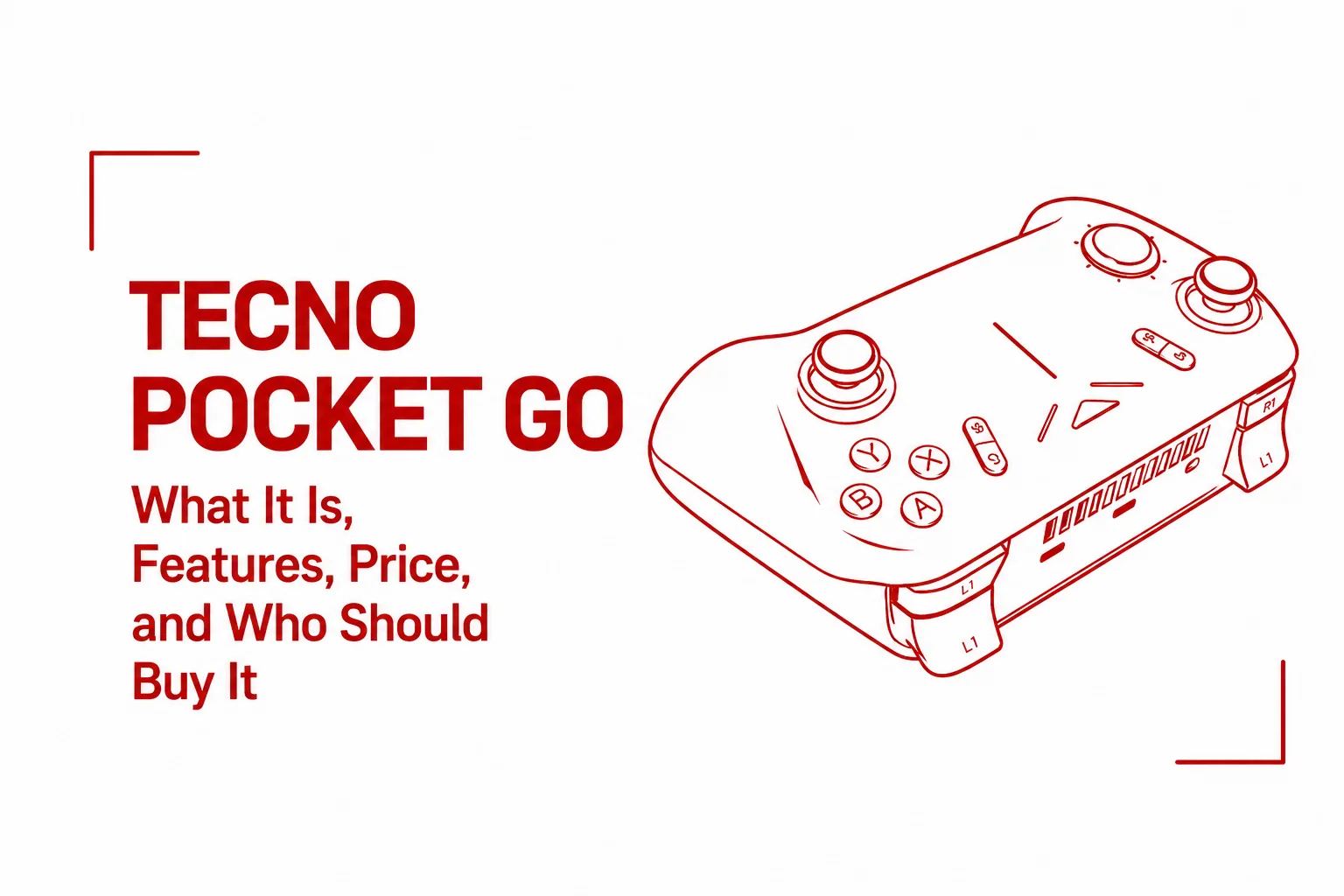
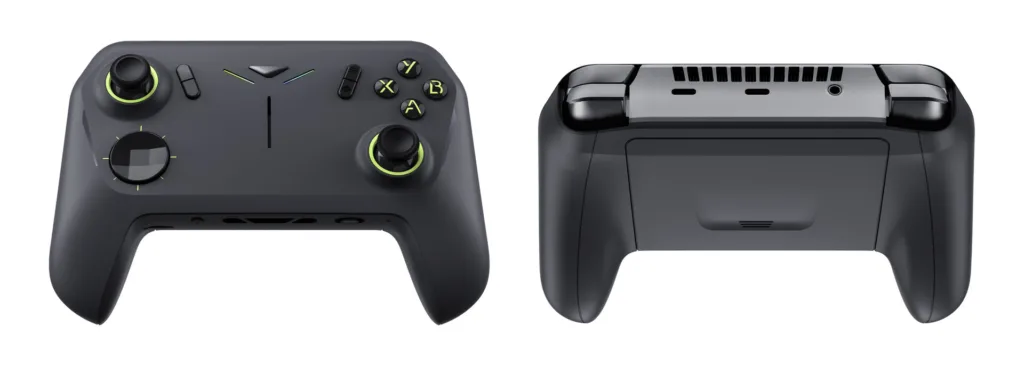
The Pocket Go packages a full Windows 11 computer inside an oversized controller chassis. There is no built-in display panel anywhere on the device. Visual output is handled entirely by a bundled pair of AR glasses called the Pocket Vision, and without them, the system has no screen to show anything on.
That setup sounds unusual at first, and it is. But the thinking behind it holds up once you work through it. Every conventional handheld gaming PC on the market today carries a screen as its heaviest, most power-hungry, and most space-consuming component. That screen dictates how large the device has to be, how much battery it drains, and how much engineering room is left over for processing hardware. Removing it changes all of those calculations at once.
Moving the display off the device and onto your face frees up the controller body to house more substantial computing hardware without the weight and size penalty of a built-in screen. The result is a device that fits inside a bag the way a game controller does, runs the full Windows 11 operating system, connects to every major gaming platform, and projects what feels like a 215-inch display directly in front of your eyes through the Pocket Vision glasses. It is a different product category, and understanding that distinction upfront shapes how the rest of the hardware makes sense.
Hardware Specifications and Performance
Tecno Pocket Go runs on an AMD Ryzen 7 8840HS processor, an 8-core, 16-thread chip with turbo frequencies peaking at 5.1 GHz. This is the same foundational architecture found inside top-tier handhelds like the ROG Ally, so the processing muscle here is not a compromise. Graphics are handled by integrated AMD Radeon 780M using the RDNA 3 architecture.
Memory options cover 16GB or 32GB of LPDDR5 RAM running at 6400 MT/s. Storage comes as either a 512GB or 1TB fast NVMe solid state drive. Both configurations are paired with the Pocket Vision AR glasses in the full system bundle.
The controller body weighs 550 grams and measures 181.7 x 129.7 x 67.4 mm. The joysticks and triggers use Hall Effect technology, which means stick drift is not something you will ever have to deal with on this controller. The button layout follows the standard Xbox-style ABXY configuration, so anyone familiar with a modern controller will feel at home immediately.
Battery capacity sits at 50 Wh with 65W fast charging support. The standout engineering detail here is that the battery is user-replaceable and hot-swappable. You can pull the cell and slot in a fresh one while the system stays connected to power, without shutting down or interrupting whatever you are playing.
A performance toggling system lets users adjust processor power draw between 10W and 30W, giving direct control over the balance between battery runtime and processing output for heavier games.
Pocket Vision AR Glasses
The Pocket Vision glasses are not an accessory. They are a functional half of the entire product. Without them, the Pocket Go has no display output at all.
Inside the frames sit dual 0.71-inch Micro-OLED display panels that project a virtual screen equivalent to watching a 215-inch television from 6 meters away. Resolution is 1080p Full HD per eye at a steady 60Hz refresh rate.
For users who wear corrective eyeglasses, the Pocket Vision includes built-in physical diopter adjustment dials covering a range from 0 to 600 degrees. Short-sighted users can dial in their prescription directly on the glasses and play without wearing their own frames underneath.
The glasses also include head tracking technology. This powers an adaptive posture feature where the virtual screen either locks in place or shifts smoothly alongside your head movements, depending on your preference. Audio is handled by dual speakers embedded into the arms of the frame, with a 3.5mm headphone jack available for private listening.
Software and Connectivity
Because the Pocket Go runs native Windows 11 Home, it functions as a complete personal computer. Every major gaming launcher works on it out of the box: Steam, Xbox Game Pass, Epic Games Store, and GOG. There are no platform restrictions or proprietary storefronts to contend with.
Physical connectivity includes two USB-C ports for charging and video output, plus a UHS-II MicroSD card slot for storage expansion beyond the built-in SSD. Wireless connectivity covers Wi-Fi 6E for fast download speeds and Bluetooth 5.2 for pairing wireless accessories.
Official Pricing
Pricing varies by configuration and what is included in the package.
- Pocket Vision AR Glasses only: $349
- Base System Kit (16GB RAM / 512GB SSD + AR Glasses): $869
- Premium System Kit (32GB RAM / 1TB SSD + AR Glasses): $1,049
Who Should Buy the Tecno Pocket Go
Frequent travelers are the most obvious fit for this device. Long flights and train journeys become a fundamentally different experience when you can pull out a controller-sized device, put on a pair of glasses, and have what feels like a 215-inch screen in front of you without occupying a tray table with a laptop or external monitor.
Privacy-focused users will find real value in a display that only they can see. No one sitting next to you on public transit can glance at your screen because, from their perspective, there is no screen to look at. For personal media consumption or gaming in shared spaces, that is an advantage no conventional handheld offers.
Tech enthusiasts and early adopters who want to engage with new form factors that push boundaries before they reach the mainstream will find the Pocket Go worth the investment.
Who Should Skip It
Casual plug-and-play handheld gamers who want to pull a device out of a pocket for a quick session while standing in line will find this setup less convenient than a Nintendo Switch or Steam Deck. Getting the Pocket Go running involves taking out the controller, connecting the glasses, and putting them on before anything appears on screen. That process adds friction that instant-on handhelds do not have.
Competitive players who need high refresh rates will run into a hard ceiling with the Pocket Vision glasses. The display maxes out at 60Hz, which is below the 120Hz or 144Hz that competitive shooter players tend to look for. For casual gaming and everyday use, 60Hz at 1080p is perfectly watchable. For fast-paced multiplayer titles where frame rate affects performance, it is a meaningful limitation.
The Tecno Pocket Go is not trying to be the best handheld gaming PC on the market. It is trying to be a different kind of device entirely, one that trades the conventional screen for a virtual one and bets that the tradeoff is worth it for the right buyer. For travelers and privacy-focused users who spend time gaming away from home, that bet lands well. For everyone else, the more traditional options still make more practical sense.