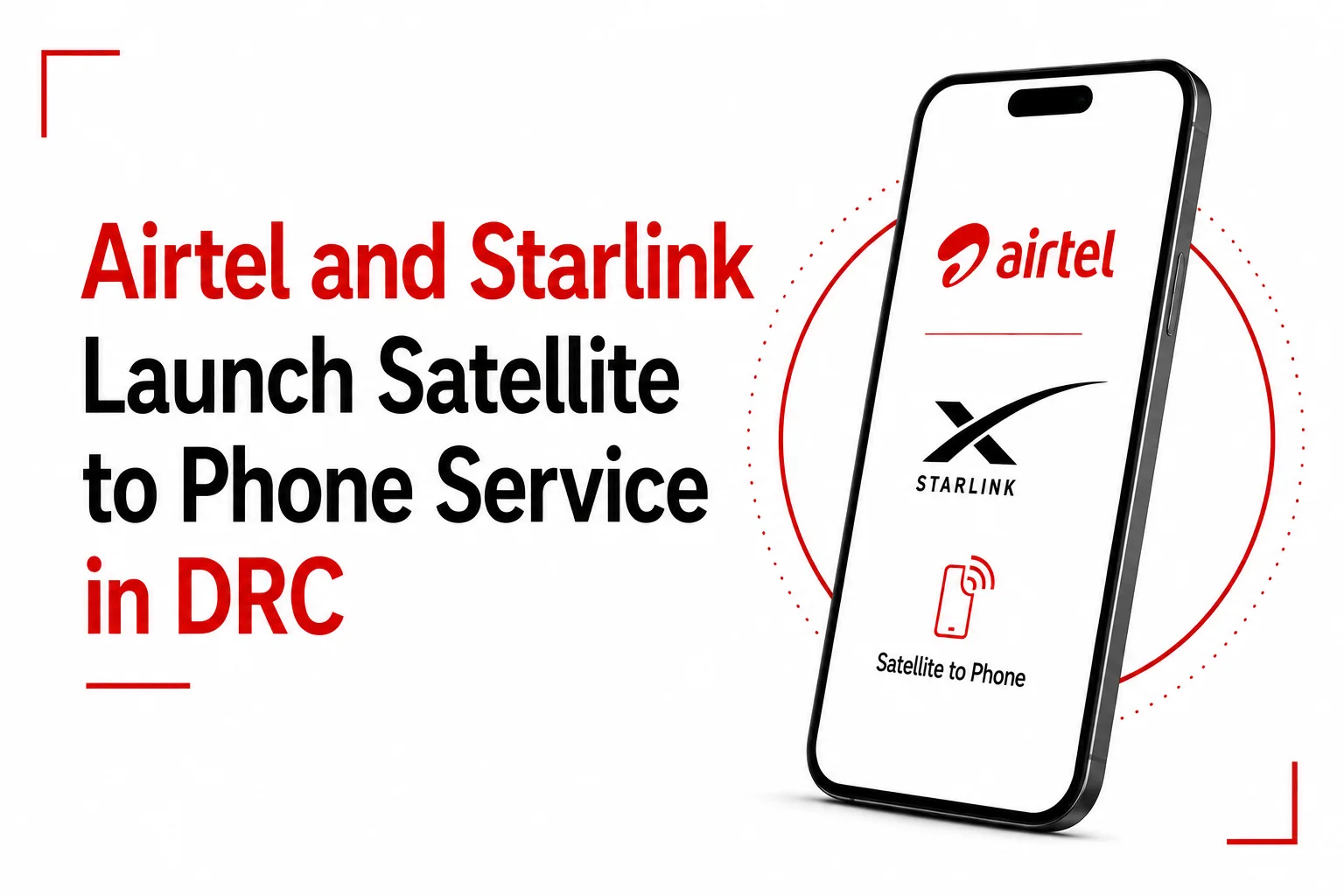

Airtel and Starlink have taken satellite to phone connectivity into commercial service in the Democratic Republic of the Congo, giving compatible Airtel customers a new way to stay connected in areas where terrestrial mobile coverage is unavailable.
The service was officially launched in Kinshasa on August 14, 2026, making the DRC the first Airtel Africa market to move the partnership into live commercial deployment. The launch follows the global partnership between Airtel Africa and SpaceX announced in December 2025, as well as earlier testing in Kenya in March 2026.
The significance of Airtel and Starlink’s move goes beyond the launch itself. It offers a glimpse into how satellite connectivity could become another layer of Africa’s mobile infrastructure, particularly in remote locations where expanding conventional networks can be difficult.
Quick Navigation
How Airtel and Starlink Satellite to Phone Service Works
The service uses Starlink’s Direct to Cell technology, which allows satellites in low Earth orbit to communicate directly with compatible mobile phones. Instead of connecting to a satellite dish or a dedicated satellite terminal, the phone communicates with the satellite in the same broad way that it connects to a terrestrial mobile network.
For customers, this means no additional satellite equipment is needed. Users with compatible LTE Android smartphones can connect directly when they have a clear, unobstructed view of the sky. Apple device support is expected through later updates.
That simplicity is one of the most important aspects of the Airtel and Starlink partnership. Traditional satellite internet has generally involved specialised hardware, which can make deployment difficult for individual users. Direct to Cell removes much of that hardware barrier by putting the satellite connection directly on the phone.
The first commercial service is focused on basic communication and light data use. Customers can send SMS messages and use supported messaging applications such as WhatsApp. The service is not yet intended to deliver the same experience as a conventional 4G or 5G connection, so high speed web browsing, voice calls, video streaming and heavy downloads are outside the initial satellite service.
The limitations are understandable given the technology’s early commercial stage. The objective is to maintain a basic connection when a terrestrial network is unavailable, not to turn every smartphone into a full satellite broadband terminal.
Airtel customers in the DRC also need an active Airtel data bundle or data roaming enabled on an eligible line. Registration and account setup are handled through the MyAirtel App. Airtel is offering customers 30 days of free introductory access. After the trial period, the service is expected to become part of Airtel’s regular data bundle structure.
What the DRC Launch Means for Airtel and Starlink
The DRC is an important market for testing the value of satellite to phone connectivity.
The country has a large geographical area and significant distances between population centres. Extending conventional mobile infrastructure into every remote location can be expensive and difficult. Satellite connectivity offers operators another option for reaching customers outside the footprint of terrestrial networks.
This does not mean Airtel and Starlink are replacing mobile towers.
Towers, fibre and conventional mobile infrastructure will continue to carry the vast majority of mobile traffic. Satellite connectivity is better understood as an additional coverage layer. A customer can rely on the terrestrial network in areas where it is available, then potentially connect through satellite when conventional coverage disappears. That could be particularly useful for people living or working in remote communities, travelling through poorly covered areas or operating in locations where building a permanent mobile site is not feasible.
The March 2026 Kenya trials provided an early indication of this model. Airtel and Starlink tested satellite connectivity with compatible 4G smartphones in areas without terrestrial coverage, with services including WhatsApp, Facebook Messenger, Maps and Airtel’s application supported during the testing phase.
The DRC launch takes that concept a step further by putting the technology into commercial use.
It also gives Airtel a market in which to assess how customers use satellite connectivity, how reliable the service is under different conditions and how the technology fits into existing mobile plans.
The commercial model will be just as important as the technology. Satellite connectivity can extend coverage, but its broader impact will depend on how accessible the service is to ordinary mobile users. Airtel’s decision to connect the service to existing data arrangements and provide an introductory trial gives the company a way to introduce the technology without forcing customers into a separate satellite subscription.
Related Article: African Countries Where Starlink Is Banned or Illegal
What Comes Next for Airtel and Starlink in Africa
The DRC rollout is only the beginning of Airtel and Starlink’s wider African plan. Airtel Africa operates in 14 markets, and the partnership with SpaceX was designed to extend satellite based connectivity across those markets. Expansion will depend on regulatory approvals in each country, since satellite services and access to mobile spectrum are subject to national telecommunications rules.
That makes the DRC launch significant beyond its immediate customer base. It provides Airtel with a working commercial model that can potentially be adapted for its other African markets once regulatory approvals are secured.
The technology itself is also expected to develop.
The current service is primarily designed around messaging and light data, but future generations of Starlink satellites are intended to support broader capabilities. Airtel has previously indicated that voice and expanded data services are part of the longer term direction of the partnership. The biggest question, therefore, is not simply how far satellite connectivity can reach. It is how effectively Airtel and Starlink can turn that reach into an affordable, dependable part of everyday mobile connectivity.
Africa’s connectivity gap cannot be solved by satellites alone. Terrestrial networks will remain essential for high capacity services and dense population areas. But Direct to Cell could help address one of the most persistent problems in mobile communications: what happens when there is no tower nearby.
For Airtel and Starlink, the DRC launch is an early commercial answer to that problem.
The service may currently be limited to basic messaging and light data, but its significance lies in the infrastructure model behind it. Instead of requiring a new tower wherever coverage ends, a compatible phone can potentially reach a satellite overhead and maintain a basic connection.
Airtel and Starlink could make satellite connectivity an extension of the African mobile network, filling coverage gaps that have remained difficult to close through terrestrial infrastructure alone.