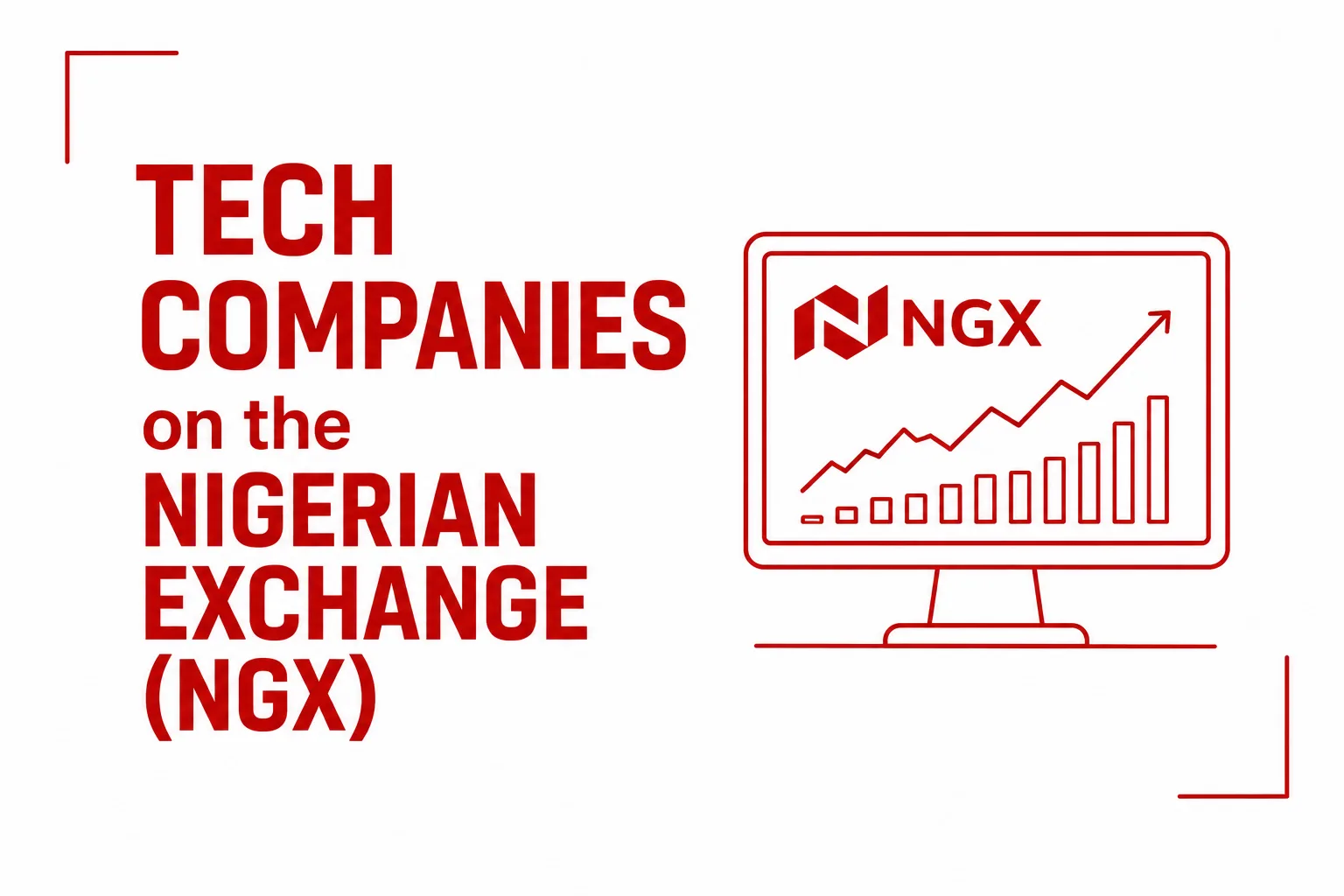

The Nigerian Exchange is widely associated with banking stocks and consumer goods conglomerates, but its technology sector tells a different story. The tech companies on the Nigerian Exchange are officially organized into three classifications: Telecommunications Services, Software and IT Services, and Computer Hardware. Together they cover everything from mobile network operators managing tens of millions of subscribers to fintech platforms processing daily banking transactions for Nigerian households. For investors and business watchers who want direct exposure to Nigeria’s digital economy through the public markets, this is the sector worth understanding.
Telecommunications Services
MTN Nigeria Communications Plc (MTNN)
MTN Nigeria is the largest mobile network operator in Nigeria, managing over 70 million subscribers across its voice and high-speed data infrastructure. It is also a subsidiary of the South African multinational MTN Group, which gives it the backing of one of the continent’s largest telecoms conglomerates.
Beyond its connectivity business, MTNN operates MoMo Payment Service Bank, a mobile money platform built specifically to push financial inclusion into rural and underserved communities where traditional banking infrastructure has not reached. This positions MTN Nigeria as both a telecommunications company and an active player in Nigeria’s growing financial inclusion agenda.
On the exchange, MTNN holds one of the largest market capitalizations on the entire bourse, making it a heavyweight not just within the technology sector but across the NGX as a whole.
Ticker: MTNN
Airtel Africa Plc (AIRTELAFRI)
Airtel Africa operates mobile telecommunications and mobile wallet services across 14 African countries, with Nigeria serving as its single largest profit driver and operational market. The company runs both connectivity infrastructure and mobile money services, mirroring the dual business model that has become standard among large African telecoms operators.
Airtel Africa stands out on the NGX because of its dual listing status. The company trades simultaneously on the London Stock Exchange and the Nigerian Exchange, which broadens its investor base significantly and signals a level of institutional credibility that few NGX-listed companies carry. Its total equity valuation frequently rivals MTNN, making these two companies the dominant forces in the telecoms segment of the exchange.
Ticker: AIRTELAFRI
Legend Internet Plc (LEGENDINT)
Legend Internet is a fiber broadband and cloud services company targeting premium residential clients and enterprise organizations. The company deploys high-speed fiber optic network infrastructure and also provides cloud storage and managed digital services to small and medium-sized businesses.
Its listing on the NGX marks it as a newer entrant to the public markets, and it sits in a different lane from the two large mobile operators above it. Where MTN and Airtel compete for mass-market mobile subscribers, Legend Internet is building out the fixed fiber infrastructure layer, the kind of high-capacity network backbone that corporate clients and upmarket residential developments need.
Ticker: LEGENDINT
Briclinks Africa Plc (BAPLC)
Briclinks Africa operates as a Virtual Mobile Network Operator, a business model where the company leases physical network infrastructure from larger carriers and uses it to offer its own specialized voice and data plans without owning the underlying towers or spectrum. Alongside this, Briclinks handles enterprise technology automation and installs private broadband setups for corporate buildings.
Ticker: BAPLC
Software and IT Services
CWG Plc (CWG)
Formerly known as Computer Warehouse Group, CWG is one of West Africa’s most established pan-African systems integrators. The company works behind the scenes for commercial banks, telecom operators, and state governments, managing core data centers, deploying banking software platforms, and handling cloud migration projects. It operates physical regional hubs across Ghana, Cameroon, and Uganda, which gives it a footprint that extends well beyond Nigeria’s borders.
Incorporated in 1991 and listed on the exchange in 2013, CWG is not a consumer-facing brand. Most Nigerians will never interact with it directly. But the digital infrastructure it manages sits underneath many of the banking and government services that millions of people use every day.
Ticker: CWG
Chams Holding Company Plc (CHAMS)
Chams is a pioneer in digital identity verification, secure smart card personalization, and electronic payment collection infrastructure. A significant portion of its revenue comes from printing automated identity cards and managing backend payment systems for public and private sector organizations. Originally founded in 1985 as a private computer services firm, it eventually restructured into a public holding company model to manage its growing portfolio of subsidiaries focused on payments and digital trust systems.
Chams sits at an interesting intersection on the NGX: it is a technology company whose work is deeply embedded in government and institutional processes, from identity documentation to payment collection. That positioning gives it a revenue base tied closely to public sector activity in Nigeria.
Ticker: CHAMS
eTranzact International Plc (ETRANZACT)
eTranzact is a multi-application electronic payment switching and processing platform. The company processes large volumes of third-party web transactions, corporate payroll payouts, airtime aggregation, and fund transfers. It also owns consumer-facing products including the PocketMoni fintech app and the PayOutlet merchant payment system.
Founded in 2003 and listed on the exchange in 2009, eTranzact functions as a pure-play fintech company on the NGX. Its business grows directly in line with the ongoing shift toward electronic banking in Nigeria, making it one of the more straightforward ways to track fintech adoption through a publicly listed vehicle.
Ticker: ETRANZACT
NCR (Nigeria) Plc (NCR)
NCR Nigeria focuses entirely on financial sector technology. The company sells, configures, installs, and services Automated Teller Machines, point-of-sale terminals, and transactional software used exclusively by Nigerian commercial banks. It is one of the oldest technology-related companies operating in Nigeria, with roots going back to 1949 when it first started local operations under the name National Cash Register Company.
In practical terms, NCR Nigeria is the company responsible for keeping a significant portion of Nigeria’s ATM infrastructure running. Its business is narrow in scope but deeply embedded in the daily functioning of the country’s banking system.
Ticker: NCR
Computer Hardware and Assembly
Omatek Ventures Plc (OMATEK)
Omatek holds a historically significant position in Nigeria’s technology story. It was the first indigenous factory to assemble computer casings, speaker systems, desktop units, and laptops locally within Nigeria, a move that stood as a direct push toward domestic manufacturing self-sufficiency in consumer technology and reducing dependence on fully imported electronics.
As market conditions around imported hardware components shifted over the years, Omatek adapted parts of its engineering operations to cover solar power system assembly and commercial LED lighting infrastructure. This shift shows a company that has always tried to build local manufacturing, first with computers and now with solar tech.
Ticker: OMATEK
Across nine listed companies and three sector classifications, the NGX technology segment covers diverse operational models. At one end sit MTN Nigeria and Airtel Africa, two of the largest companies on the entire exchange by market capitalization. At the other end sit earlier-stage players like Briclinks and growth-oriented firms like Legend Internet, which are building out the next layer of Nigeria’s digital infrastructure.
These nine companies make up the complete technology sector on the Nigerian Exchange as it stands today.